
04-05 Water flowing into triangular trough
Problem 04
A triangular trough 10 ft long is 4 ft across the top, and 4 ft deep. If water flows in at the rate of 3 ft3/min, find how fast the surface is rising when the water is 6 in deep.
- Read more about 04-05 Water flowing into triangular trough
- Log in or register to post comments
03 Water flowing into rectangular trough
Problem 03
A rectangular trough is 10 ft long and 3 ft wide. Find how fast the surface rises, if water flows in at the rate of 12 ft3/min.
- Read more about 03 Water flowing into rectangular trough
- Log in or register to post comments
01-02 Water flowing into cylindrical tank
Problem 01
Water is flowing into a vertical cylindrical tank at the rate of 24 ft3/min. If the radius of the tank is 4 ft, how fast is the surface rising?
Problem 02
Water flows into a vertical cylindrical tank at 12 ft3/min, the surface rises 6 in/min. Find the radius of the tank.
- Read more about 01-02 Water flowing into cylindrical tank
- Log in or register to post comments
Solution to Problem 675 | Midspan Deflection
Problem 675
Repeat Prob. 674 for the overhanging beam shown in Fig. P-675.
- Read more about Solution to Problem 675 | Midspan Deflection
- Log in or register to post comments
Solution to Problem 674 | Midspan Deflection
Problem 674
Find the deflection midway between the supports for the overhanging beam shown in Fig. P-674.

- Read more about Solution to Problem 674 | Midspan Deflection
- Log in or register to post comments
Solution to Problem 673 | Midspan Deflection
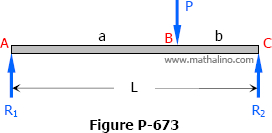
Problem 673
For the beam shown in Fig. P-673, show that the midspan deflection is δ = (Pb/48EI) (3L2 - 4b2).

- Read more about Solution to Problem 673 | Midspan Deflection
- Log in or register to post comments
Midspan Deflection | Deflections in Simply Supported Beams
In simply supported beams, the tangent drawn to the elastic curve at the point of maximum deflection is horizontal and parallel to the unloaded beam. It simply means that the deviation from unsettling supports to the horizontal tangent is equal to the maximum deflection. If the simple beam is symmetrically loaded, the maximum deflection will occur at the midspan.
Spherical Wedge and Spherical Lune
A spherical wedge is a solid formed by revolving a semi-circle about its diameter by less than 360°. Spherical Lune is the curve surface of the wedge, it is a surface formed by revolving a semi-circular arc about its diameter by less than 360°.
- Read more about Spherical Wedge and Spherical Lune
- Log in or register to post comments
Spherical Sector
A spherical sector is a solid generated by revolving a sector of a circle about an axis which passes through the center of the circle but which contains no point inside the sector. If the axis of revolution is one of the radial sides, the sector thus formed is spherical cone; otherwise, it is open spherical sector.
- Read more about Spherical Sector
- Log in or register to post comments
Spherical Segment
Spherical segment is a solid bounded by two parallel planes through a sphere. In terms of spherical zone, spherical segment is a solid bounded by a zone and the planes of a zone's bases.
- Read more about Spherical Segment
- Log in or register to post comments


Recent comments