Problem 540 | Friction on Wedges

Problem 540
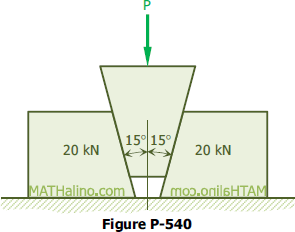
As shown in Fig. P-540, two blocks each weighing 20 kN and resting on a horizontal surface, are to be pushed apart by a 30° wedge. The angle of friction is 15° for all contact surfaces. What value of P is required to start movement of the blocks? How would this answer be changed if the weight of one of the blocks were increased by 30 kN?
 

540-wedge-block-friction.gif


Problem 539 | Friction on Wedges

Problem 539
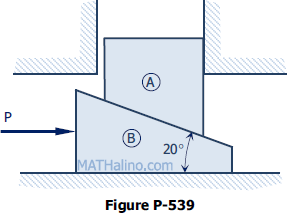
The block A in Fig. P-539 supports a load W = 100 kN and is to be raised by forcing the wedge B under it. The angle of friction for all surfaces in contact is f = 15°. If the wedge had a weight of 40 kN, what value of P would be required (a) to start the wedge under the block and (b) to pull the wedge out from under the block?
 

539-block-wedge.gif


Problem 533 | Friction

Problem 533
A uniform bar AB, weighing 424 N, is fastened by a frictionless pin to a block weighing 200 N as shown in Fig. P-533. At the vertical wall, μ = 0.268 while under the block, μ = 0.20. Determine the force P needed to start motion to the right.
 

Bar and block assembly


Problem 532 | Friction

Problem 532
In Fig. P-532, two blocks each weighing 1.5 kN are connected by a uniform horizontal bar which weighs 1.0 kN. If the angle of friction is 15° under each block, find P directed parallel to the 45° incline that will cause impending motion to the left.
 

Blocks on inclined planes connected by horizontal bar


Problem 531 | Friction

Problem 531
A uniform plank of weight W and total length 2L is placed as shown in Fig. P-531 with its ends in contact with the inclined planes. The angle of friction is 15°. Determine the maximum value of the angle α at which slipping impends.
 

Plank resting at some angle on two inclined planes