
Derivation of Formula for Radius of Circumcircle
The formula for the radius of the circle circumscribed about a triangle (circumcircle) is given by
where At is the area of the inscribed triangle.
- Read more about Derivation of Formula for Radius of Circumcircle
- Log in or register to post comments
Derivation of Formula for Radius of Incircle
The radius of incircle is given by the formula
where At = area of the triangle and s = semi-perimeter.
- Read more about Derivation of Formula for Radius of Incircle
- Log in or register to post comments
Centers of a Triangle
This page will define the following: incenter, circumcenter, orthocenter, centroid, and Euler line.
Incenter
Incenter is the center of the inscribed circle (incircle) of the triangle, it is the point of intersection of the angle bisectors of the triangle.

The radius of incircle is given by the formula
where At = area of the triangle and s = ½ (a + b + c). See the derivation of formula for radius of incircle.
- Read more about Centers of a Triangle
- Log in or register to post comments
Properties of Triangle
Side
Side of a triangle is a line segment that connects two vertices. Triangle has three sides, it is denoted by a, b, and c in the figure below.
Vertex
Vertex is the point of intersection of two sides of triangle. The three vertices of the triangle are denoted by A, B, and C in the figure below. Notice that the opposite of vertex A is side a, opposite to vertex B is side B, and opposite to vertex C is side c.
- Read more about Properties of Triangle
- Log in or register to post comments
Derivation of Cosine Law
The following are the formulas for cosine law for any triangles with sides a, b, c and angles A, B, C, respectively.
$b^2 = a^2 + c^2 - 2ac\cos B$
$c^2 = a^2 + b^2 - 2ab\cos C$
- Read more about Derivation of Cosine Law
- Log in or register to post comments
Derivation of Sine Law
For any triangles with vertex angles and corresponding opposite sides are A, B, C and a, b, c, respectively, the sine law is given by the formula...
- Read more about Derivation of Sine Law
- Log in or register to post comments
Derivation of the Half Angle Formulas
Half angle formulas can be derived from the double angle formulas, particularly, the cosine of double angle. For easy reference, the cosines of double angle are listed below:
cos 2θ = 2cos2 θ - 1 → Equation (2)
Note that the equations above are identities, meaning, the equations are true for any value of the variable θ. The key on the derivation is to substitute θ with ½ θ.
- Read more about Derivation of the Half Angle Formulas
- Log in or register to post comments
Derivation of Basic Identities
The derivation of basic identities can be done easily by using the functions of a right triangle. For easy reference, these trigonometric functions are listed below.
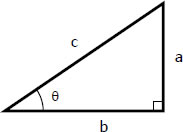 a/c = sin θ
b/c = cos θ
a/b = tan θ
c/a = csc θ
c/b = sec θ
b/a = cot θ
- Read more about Derivation of Basic Identities
- Log in or register to post comments
Functions of a Right Triangle
From the right triangle shown below,
the trigonometric functions of angle θ are defined as follows:
- Read more about Functions of a Right Triangle
- Log in or register to post comments
Summary of Trigonometric Identities
Basic Identities
See the derivation of basic identities.
- $\sin \theta = \dfrac{1}{\csc \theta} ~ \Leftrightarrow ~ \csc \theta = \dfrac{1}{\sin \theta}$
- $\cos \theta = \dfrac{1}{\sec \theta} ~ \Leftrightarrow ~ \sec \theta = \dfrac{1}{\cos \theta}$
- $\tan \theta = \dfrac{\sin \theta}{\cos \theta} = \dfrac{1}{\cot \theta} ~ \Leftrightarrow ~ \cot \theta = \dfrac{\cos \theta}{\sin \theta} = \dfrac{1}{\tan \theta}$
- Read more about Summary of Trigonometric Identities
- Log in or register to post comments
Recent comments
is it not…