Back to top
Introduction
This post is a follow-up to the discussion on Cycloidal Curves, where we explored circles rolling along straight paths or other circular orbits. The mathematics governing those roulettes is relatively straightforward because the rolling paths are defined by simple geometric relationships. For example, when a circle rolls on another circle without slipping, the distance traveled along the path is described by the simple formula $s = r\theta$.
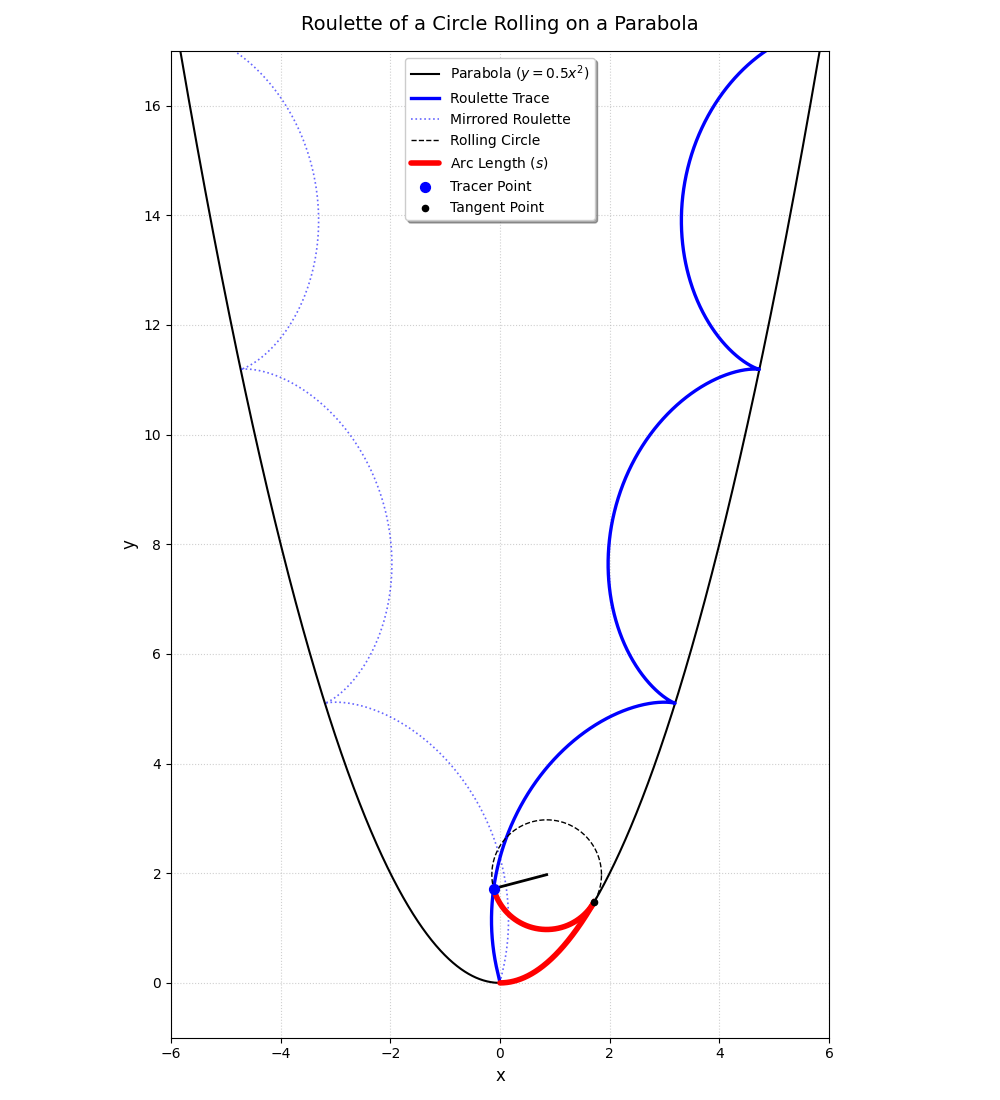
I began to wonder: what happens if a circle rolls along a path with a more complex geometry? The first curve that came to mind was the parabola. Let’s explore the derivation for a Parabolic Roulette.
Back to top
Properties of Parabola Used in the Calculations
We take an upward parabola with vertex at the origin and length of latus rectum $LR = 1/k$. Hence,
$y = kx^2$
$y' = 2kx$
Let the angle of inclination of the tangent line be $\phi$. Then
$\tan \phi = 2kx$
$\phi = \arctan 2kx$
Length of Arc of the Parabola, $s$:
To determine how far the circle has rolled, we calculate the arc length of the parabola measured from the vertex:
$\displaystyle ds = \int \sqrt{1 + (y')^2} \, dx$
$\displaystyle s = \int_0^x \sqrt{1 + (2kt)^2} \, dt$
$s = \dfrac{1}{4k} \left[ 2kx \sqrt{1 + (2kx)^2} + \operatorname{arcsinh} (2kx) \right]$
Details of Integration
$s = \displaystyle \int \sqrt{1 + (2kx)^2} dx$
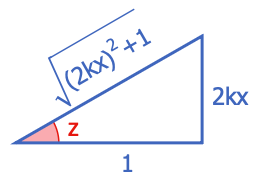
Let $2kx = \tan z$
$dx = \dfrac{\sec^2 z}{2k} dz$
$s = \displaystyle \int \sqrt{1 + \tan^2 z} \cdot \dfrac{\sec^2 z}{2k} dz = \dfrac{1}{2k} \int \sqrt{1 + \tan^2 z} \sec^2 z \, dz$
$s = \displaystyle \dfrac{1}{2k} \int \sqrt{\sec^2 z} \sec^2 z \, dz = \dfrac{1}{2k} \int \sec^3 z \, dz$
For $\displaystyle \int \sec^3 z \, dz$, use integration by parts
$\displaystyle \int u \, dv = uv - \int v \, du$
$u = \sec z$
$du = \sec z \, \tan z \, dz$
$dv = \sec^2 z \, dz$
$v = \displaystyle \int \sec^2 z \, dz = \tan z$
$\displaystyle \int \sec^3 z \, dz = \sec z \, \tan z - \int \sec z \, \tan^2 z \, dz$
$\displaystyle \int \sec^3 z \, dz = \sec z \, \tan z - \int \sec z \, (\sec^2 z - 1) \, dz$
$\displaystyle \int \sec^3 z \, dz = \sec z \, \tan z - \int \sec^3 z \, dz + \int \sec z\, dz$
$\displaystyle 2\int \sec^3 z \, dz = \sec z \, \tan z + \ln (\sec z + \tan z) + C$
$\displaystyle \int_0^z \sec^3 t \, dt = \dfrac{1}{2} \left[ \sec z \, \tan z + \ln (\sec z + \tan z) \right]$
Hence,
$s = \dfrac{1}{2k} \cdot \dfrac{1}{2} \left[ \sec z \, \tan z + \ln (\sec z + \tan z) \right]$
From
$\tan z = 2kx$
$\sec z = \sqrt{(2kx)^2 + 1}$
$s = \dfrac{1}{4k} \left[ 2kx \sqrt{(2kx)^2 + 1} + \ln \left( \sqrt{(2kx)^2 + 1} + 2kx \right) \right]$
Use the indintity $\ln \left( \sqrt{u^2 + 1} + u \right) = \operatorname{arcsinh} u$
For $u = 2kx$
$\ln \left( \sqrt{(2kx)^2 + 1} + 2kx \right) = \operatorname{arcsinh} (2kx)$
Hence,
$s = \dfrac{1}{4k} \left[ 2kx \sqrt{1 + (2kx)^2} + \operatorname{arcsinh} (2kx) \right]$
Detailed process without the use of the identity $\ln \left( \sqrt{u^2 + 1} + u \right) = \operatorname{arcsinh} u$
Click here to expand or collapse this section
Let $f(x) = \ln \left( \sqrt{(2kx)^2 + 1} + 2kx \right)$
Use $\dfrac{d}{dx} (\ln u) = \dfrac{du/dx}{u} = \dfrac{1}{u} \cdot \dfrac{d}{dx}(u)$
$f'(x) = \dfrac{1}{\sqrt{(2kx)^2 + 1} + 2kx} \cdot \dfrac{d}{dx}\left[ \sqrt{(2kx)^2 + 1} + 2kx \right]$
$f'(x) = \dfrac{1}{\sqrt{(2kx)^2 + 1} + 2kx} \cdot \left[ \dfrac{2(2kx)(2k)}{2\sqrt{(2kx)^2 + 1}} + 2k \right]$
$f'(x) = \dfrac{1}{\sqrt{(2kx)^2 + 1} + 2kx} \cdot \left[ \dfrac{4k^2 x}{\sqrt{(2kx)^2 + 1}} + 2k \right]$
$f'(x) = \dfrac{1}{\sqrt{(2kx)^2 + 1} + 2kx} \cdot \dfrac{4k^2 x + 2k\sqrt{(2kx)^2 + 1}}{\sqrt{(2kx)^2 + 1}}$
$\require{cancel} f'(x) = \dfrac{1}{\cancel{\sqrt{(2kx)^2 + 1} + 2kx}} \cdot \dfrac{2k \left( \cancel{2kx + \sqrt{(2kx)^2 + 1}} \right)}{\sqrt{(2kx)^2 + 1}}$
$f'(x) = \dfrac{2k}{\sqrt{(2kx)^2 + 1}}$
Integrate both sides
Note: $\displaystyle \int \dfrac{du}{\sqrt{u^2 + 1}} = \operatorname{arcsinh} u + C$
Hence,
$\displaystyle f(x) = \int_0^x \dfrac{2t}{\sqrt{(2kt)^2 + 1}}$
$f(x) = \operatorname{arcsinh} (2kx)$
Therefore,
$s = \dfrac{1}{4k} \left[ 2kx \sqrt{1 + (2kx)^2} + \operatorname{arcsinh} (2kx) \right]$
Back to top
Angle of Rotation $\beta$ of the Rolling Circle
Assuming the circle rolls without slipping, the arc length $s$ must equal the circular arc $r \beta$:
$r \beta = s$
$\beta = s/r$
$\beta = \dfrac{1}{4kr} \left[ 2kx \sqrt{1 + (2kx)^2} + \operatorname{arcsinh} (2kx) \right]$
Back to top
Case 1: Rolling on the concave side of the parabola
Center of Rolling Circle $(x_C, y_C)$
Using the normal line to the curve at point $T(x, y)$:
$x_C = x - r \sin \phi$
$y_C = y + r \cos \phi$
Coordinates of the Tracing Point $P$:
To find the position of point $P(x_P, y_P)$, we define the angle $\theta$ relative to the circle's center:
$\theta + \beta - \phi + \dfrac{\pi}{2} = 2\pi$
$\implies \theta = \dfrac{3\pi}{2} + \phi - \beta$
$x_P = x_C + r \cos \theta$
$y_P = y_C + r \sin \theta$
Back to top
Case 2: Rolling on the convex side of the parabola
If the circle rolls on the convex side (underneath) of the parabola, the logic remains the same, but the orientation of the center and the rotation angle adjust accordingly.
Center of rolling circle
With reference to the figure above.
$x_C = x + r \sin \phi$
$y_C = y - r \cos \phi$
Location of $P$
$\theta = \dfrac{\pi}{2} + \phi + \beta$
While the parametric equations for the coordinates of $P$ remain identical to those in Case 1, they rely on a different geometric definition for $\theta$.
$x_P = x_C + r \cos \theta$
$y_P = y_C + r \sin \theta$
Back to top
Animate in Manim
The ultimate goal of this post is to animate the parabolic roulette with mathematical precision. The code shown below was developed with AI assistance, while its mathematical formulation was carefully verified by MATHalino. Since the focus of this article is the mathematics behind the curve, the table that follows highlights how the key Calculus results are translated into Python code.
| Component |
Equation |
Python Code |
| Parabola |
$y = kx^2$ |
def y_parabola(x): return k * x**2
|
| Tangent angle |
$\phi = \arctan (2kx)$ |
def phi(x): return np.arctan(2 * k * x)
|
| Arc length |
$\displaystyle s = \int \sqrt{1+(2kx)^2} \, dx$ |
def arc_length(x):
    return 0.5 * x * np.sqrt(1 + 4 * k**2 * x**2)
        + np.arcsinh(2 * k * x) / (4 * k)
|
| Center above parabola |
$x_C = x - r \sin \phi$
$y_C = y + r \cos \phi$ |
def center_point_above(x):
    a = phi(x)
    return np.array([
        x - r * np.sin(a),
        y_parabola(x) + r * np.cos(a),
        0
    ])
|
| Center below parabola |
$x_C = x + r \sin \phi$
$y_C = y - r \cos \phi$ |
def center_point_below(x):
    a = phi(x)
    return np.array([
        x + r * np.sin(a),
        y_parabola(x) - r * np.cos(a),
        0
    ])
|
| Tracing angle above |
$\displaystyle \theta = \frac{3\pi}{2} + \phi - \frac{s}{r}$ |
inside tracer_point_above(x):
theta = 1.5 * PI + a - s / r
|
| Tracing angle below |
$\displaystyle \theta = \frac{\pi}{2} + \phi + \frac{s}{r}$ |
inside tracer_point_below(x):
theta = PI / 2 + a + s / r
|
| Coordinates of $(x_P, y_P)$ |
$x_P = x_C + r \cos \theta$
$y_P = y_C + r \sin \theta$ |
c = center_point_above(x) # For Case 1
c = center_point_below(x) # For Case 2
return np.array([
    c[0] + r * np.cos(theta),
    c[1] + r * np.sin(theta),
    0
])
|
Video Output
Full code for Manim
Back to top
Area and Length of Arc
We will attempt to solve for the area and arc length of one cusp of the parabolic roulette. Keep in mind that the curvature of the path changes at every point. Our goal is to establish the working equations and then use Python to compute the required values.
The Geometry of Case 1
For easier reading, the calculations above are extracted and listed below.
The Parabola
$y = kx^2$
$y' = 2kx$
$y'' = 2k$
$\tan \phi = y'$
$\tan \phi = 2kx$
$\phi = \arctan (2kx)$
Center of the Rolling Circle
$x_C = x - r\sin \phi$
$y_C = y + r\cos \phi$
Length of Arc of the Parabola
$s = \dfrac{1}{4k} \left[ 2kx \sqrt{1 + (2kx)^2} + \operatorname{arcsinh} (2kx) \right]$
Angle Subtended at the Center of the Rolling Circle
$\beta = \dfrac{s}{r}$
The Angle $\theta$
$\theta = \dfrac{3\pi}{2} + \phi - \beta$
The Coordinates of the Tracing Point
$x_P = x_C + r \cos \theta$
$y_P = y_C + r \sin \theta$
Parameterization
Our goal is to express the equations in terms of \(\phi\), the angle of inclination of the tangent at \(T\).
The Rolling Circle
$x_C = x - r\sin \phi$
$x_C = \dfrac{\tan \phi}{2k} - r\sin \phi$
$\dfrac{dx_C}{d\phi} = \dfrac{\sec^2 \phi}{2k} - r\cos \phi$
$y_C = y + r\cos \phi$
$y_C = kx^2 + r\cos \phi$
$y_C = k\left( \dfrac{\tan \phi}{2k} \right)^2 + r\cos \phi$
$y_C = \dfrac{\tan^2 \phi}{4k} + r\cos \phi$
$\dfrac{dy_C}{d\phi} = \dfrac{2 \tan \phi \sec^2 \phi}{4k} - r\sin \phi$
$\dfrac{dy_C}{d\phi} = \dfrac{\tan \phi \sec^2 \phi}{2k} - r\sin \phi$
Distance Travelled by the Rolling Circle
$s = \dfrac{1}{4k} \left[ 2kx \sqrt{1 + (2kx)^2} + \operatorname{arcsinh} (2kx) \right]$
$s = \dfrac{1}{4k} \left[ \tan \phi \sqrt{1 + \tan^2 \phi} + \operatorname{arcsinh} (\tan \phi) \right]$
$s = \dfrac{1}{4k} \left[ \tan \phi \sqrt{\sec^2 \phi} + \operatorname{arcsinh} (\tan \phi) \right]$
$s = \dfrac{1}{4k} \left[ \tan \phi \sec \phi + \operatorname{arcsinh} (\tan \phi) \right]$
The Angle $\beta$
$\beta = \dfrac{s}{r}$
$\beta = \dfrac{1}{4kr} \left[ \tan \phi \sec \phi + \operatorname{arcsinh} (\tan \phi) \right]$
The Tracing Point
$x_P = x_C + r\cos \theta$
$x_P = x_C + r\cos \left( \dfrac{3\pi}{2} + \phi - \beta \right)$
From $\cos (A + B) = \cos A \cos B - \sin A \sin B$
Use $A = 3\pi/2$ and $B = \phi - \beta$
$\cos \left[ \left( \dfrac{3\pi}{2} \right) + \left( \phi - \beta \right) \right] = \cos \left( \dfrac{3\pi}{2} \right) \cos \left( \phi - \beta \right) - \sin \left( \dfrac{3\pi}{2} \right) \sin \left( \phi - \beta \right)$
$\cos \left( \dfrac{3\pi}{2} + \phi - \beta \right) = 0 \cdot \cos \left( \phi - \beta \right) - (-1) \cdot \sin \left( \phi - \beta \right)$
$\cos \left( \dfrac{3\pi}{2} + \phi - \beta \right) = \sin \left( \phi - \beta \right)$
$x_P = x_C + r\sin \left( \phi - \beta \right)$
Let $\psi = \phi - \beta$
$\dfrac{d\psi}{d\phi} = 1 - \dfrac{d\beta}{d\phi}$
$x_P = x_C + r\sin \psi$
$\dfrac{dx_P}{d\phi} = \dfrac{dx_C}{d\phi} + r\cos \psi \cdot \dfrac{d\psi}{d\phi}$
$\left( \dfrac{dx_P}{d\phi} \right)^2 = \left( \dfrac{dx_C}{d\phi} + r\cos \psi \cdot \dfrac{d\psi}{d\phi} \right)^2$
$\left( \dfrac{dx_P}{d\phi} \right)^2 = \left( \dfrac{dx_C}{d\phi} \right)^2 + 2 \cdot \dfrac{dx_C}{d\phi} \cdot \left( r\cos \psi \cdot \dfrac{d\psi}{d\phi} \right) + \left( r\cos \psi \cdot \dfrac{d\psi}{d\phi} \right)^2$
$\left( \dfrac{dx_P}{d\phi} \right)^2 = \left( \dfrac{dx_C}{d\phi} \right)^2 + \left( 2r \cos \psi \cdot \dfrac{dx_C}{d\phi} \right) \cdot \dfrac{d\psi}{d\phi} + \left( r\cos \psi \cdot \dfrac{d\psi}{d\phi} \right)^2$
$y_P = y_C + r \sin \theta$
$y_P = y_C + r \sin \left( \dfrac{3\pi}{2} + \phi - \beta \right)$
From $\sin (A + B) = \sin A \cos B + \cos A \sin B$
Use $A = 3\pi/2$ and $B = \phi - \beta$
$\sin \left[ \left( \dfrac{3\pi}{2} \right) + \left( \phi - \beta \right) \right] = \sin \left( \dfrac{3\pi}{2} \right) \cos \left( \phi - \beta \right) - \cos \left( \dfrac{3\pi}{2} \right) \sin \left( \phi - \beta \right)$
$\sin \left( \dfrac{3\pi}{2} + \phi - \beta \right) = (-1) \cdot \cos \left( \phi - \beta \right) - 0 \cdot \sin \left( \phi - \beta \right)$
$\sin \left( \dfrac{3\pi}{2} + \phi - \beta \right) = -\cos \left( \phi - \beta \right)$
$y_P = y_C - r \cos \left( \phi - \beta \right)$
$y_P = y_C - r \cos \psi$
$\dfrac{dy_P}{d\phi} = \dfrac{dy_C}{d\phi} + r\sin \psi \cdot \dfrac{d\psi}{d\phi}$
$\left( \dfrac{dy_P}{d\phi} \right)^2 = \left( \dfrac{dy_C}{d\phi} + r\sin \psi \cdot \dfrac{d\psi}{d\phi} \right)^2$
$\left( \dfrac{dy_P}{d\phi} \right)^2 = \left( \dfrac{dy_C}{d\phi} \right)^2 + 2 \cdot \dfrac{dy_C}{d\phi} \cdot \left( r\sin \psi \cdot \dfrac{d\psi}{d\phi} \right) + \left( r\sin \psi \cdot \dfrac{d\psi}{d\phi} \right)^2$
$\left( \dfrac{dy_P}{d\phi} \right)^2 = \left( \dfrac{dy_C}{d\phi} \right)^2 + \left( 2r \sin \psi \cdot \dfrac{dy_C}{d\phi} \right) \cdot \dfrac{d\psi}{d\phi} + \left( r\sin \psi \cdot \dfrac{d\psi}{d\phi} \right)^2$
$\begin{align}
\left( \dfrac{dx_P}{d\phi} \right)^2 + \left( \dfrac{dy_P}{d\phi} \right)^2 = & \left[ \left( \dfrac{dx_C}{d\phi} \right)^2 + \left( \dfrac{dy_C}{d\phi} \right)^2 \right] + \left[ 2r \left( \cos \psi \cdot \dfrac{dx_C}{d\phi} + \sin \psi \cdot \dfrac{dy_C}{d\phi} \right) \cdot \dfrac{d\psi}{d\phi} \right] \\ & + \left[ r^2\left( \cos^2 \psi + \sin^2 \psi \right) \cdot \left( \dfrac{d\psi}{d\phi} \right)^2 \right]
\end{align}$
$\left( \dfrac{dx_P}{d\phi} \right)^2 + \left( \dfrac{dy_P}{d\phi} \right)^2 = \left( \dfrac{ds_C}{d\phi} \right)^2 + 2r \left( \cos \psi \cdot \dfrac{dx_C}{d\phi} + \sin \psi \cdot \dfrac{dy_C}{d\phi} \right) \cdot \dfrac{d\psi}{d\phi} + r^2 \left( \dfrac{d\psi}{d\phi} \right)^2$
Speed of the rolling circle:
The first part of the expansion, \(\dfrac{ds_C}{d\phi}\), is the speed of the
center of the rolling circle.
Speed of the tracing point:
The quantity \(r \cdot \dfrac{d\psi}{d\phi}\) is the speed of point \(P\) relative to the center of the circle, \(C\).
From the middle term of the expansion:
$M = 2r \left( \cos \psi \cdot \dfrac{dx_C}{d\phi} + \sin \psi \cdot \dfrac{dy_C}{d\phi} \right) \cdot \dfrac{d\psi}{d\phi}$
$M = 2r \left[ \cos \psi \cdot \left( \dfrac{\sec^2 \phi}{2k} - r\cos \phi \right) + \sin \psi \cdot \left( \dfrac{\tan \phi \sec^2 \phi}{2k} - r\sin \phi \right) \right] \cdot \dfrac{d\psi}{d\phi}$
$M = 2r \left[ \left( \cos \psi \dfrac{\sec^2 \phi}{2k} - r \cos \psi \cos \phi \right) + \left( \sin \psi \dfrac{\tan \phi \sec^2 \phi}{2k} - r\sin \psi \sin \phi \right) \right] \cdot \dfrac{d\psi}{d\phi}$
$M = 2r \left[ \dfrac{\sec^2 \phi}{2k} \left( \cos \psi + \sin \psi \tan \phi \right) - r \left( \cos \psi \cos \phi + \sin \psi \sin \phi \right) \right] \cdot \dfrac{d\psi}{d\phi}$
$M = 2r \left[ \dfrac{\sec^2 \phi}{2k} \left( \cos \psi + \sin \psi \cdot \dfrac{\sin \phi}{\cos \phi} \right) - r \left( \cos \psi \cos \phi + \sin \psi \sin \phi \right) \right] \cdot \dfrac{d\psi}{d\phi}$
$M = 2r \left[ \dfrac{\sec^2 \phi}{2k} \left( \dfrac{\cos \psi \cos \phi + \sin \psi \sin \phi}{\cos \phi} \right) - r \left( \cos \psi \cos \phi + \sin \psi \sin \phi \right) \right] \cdot \dfrac{d\psi}{d\phi}$
$M = 2r \left[ \dfrac{\sec^3 \phi}{2k} \left( \cos \psi \cos \phi + \sin \psi \sin \phi \right) - r \left( \cos \psi \cos \phi + \sin \psi \sin \phi \right) \right] \cdot \dfrac{d\psi}{d\phi}$
$M = 2r \left[ \left( \dfrac{\sec^3 \phi}{2k} - r \right) \left( \cos \phi \cos \psi + \sin \phi \sin \psi \right) \right] \cdot \dfrac{d\psi}{d\phi}$
From $\cos (A - B) = \cos A \cos B + \sin A \sin B$
Use $A = \phi$ and $B = \psi$
$\cos \phi \cos \psi + \sin \phi \sin \psi = \cos \left( \phi - \psi \right)$
$M = 2r \left[ \left( \dfrac{\sec^3 \phi}{2k} - r \right) \cdot \cos \left( \phi - \psi \right) \right] \cdot \dfrac{d\psi}{d\phi}$
$M = 2r \cos (\phi - \psi) \cdot \left( \dfrac{\sec^3 \phi}{2k} - r \right) \cdot \dfrac{d\psi}{d\phi}$
From $\psi = \phi - \beta$, then $\phi - \psi = \beta$
$M = 2r \cos \beta \cdot \left( \dfrac{\sec^3 \phi}{2k} - r \right) \cdot \dfrac{d\psi}{d\phi}$
Hence,
$\left( \dfrac{dx_P}{d\phi} \right)^2 + \left( \dfrac{dy_P}{d\phi} \right)^2 = \left( \dfrac{ds_C}{d\phi} \right)^2 + 2r \cos \beta \cdot \left( \dfrac{\sec^3 \phi}{2k} - r \right) \cdot \dfrac{d\psi}{d\phi} + r^2 \left( \dfrac{d\psi}{d\phi} \right)^2$
Radius of Curvature of the Parabola
\( \rho = \dfrac{\left[ 1 + \left( y' \right)^2 \right]^{3/2}}{\left| y'' \right|} \)
$\rho = \dfrac{\left[ 1 + \tan^2 \phi \right]^{3/2}}{\left| 2k \right|} = \dfrac{\left( \sec^2 \phi \right)^{3/2}}{2k}$
$\rho = \dfrac{\sec^3 \phi}{2k}$
$\left( \dfrac{dx_P}{d\phi} \right)^2 + \left( \dfrac{dy_P}{d\phi} \right)^2 = \left( \dfrac{ds_C}{d\phi} \right)^2 + 2r \cos \beta \cdot (\rho - r) \cdot \dfrac{d\psi}{d\phi} + r^2 \left( \dfrac{d\psi}{d\phi} \right)^2$
$\left( \dfrac{dx_P}{d\phi} \right)^2 + \left( \dfrac{dy_P}{d\phi} \right)^2 = \left( \dfrac{ds_C}{d\phi} \right)^2 + 2r (\rho - r) \cos \beta \cdot \dfrac{d\psi}{d\phi} + r^2 \left( \dfrac{d\psi}{d\phi} \right)^2$
Since \(\rho\) is the radius of curvature of the parabola, \(\rho - r\) is the effective radius of motion of the center of the rolling circle.
Hence, $ds_C = (\rho - r) \, d\phi$
$\dfrac{ds_C}{d\phi} = \rho - r$
Also, the differential length of arc of the parabola, $ds = \rho \, d\phi$
$\dfrac{ds}{d\phi} = \rho$
From $s = r \beta$
$\dfrac{ds}{d\phi} = r \, \dfrac{d\beta}{d\phi}$
Equate $ds/d\phi$
$r \, \dfrac{d\beta}{d\phi} = \rho$
$\dfrac{d\beta}{d\phi} = \dfrac{\rho}{r}$
From $\psi = \phi - \beta$
$\dfrac{d\psi}{d\phi} = 1 - \dfrac{d\beta}{d\phi}$
$\dfrac{d\psi}{d\phi} = 1 - \dfrac{\rho}{r} = \dfrac{r - \rho}{\rho}$
$\dfrac{d\psi}{d\phi} = -\dfrac{\rho - r}{r}$
$\left( \dfrac{dx_P}{d\phi} \right)^2 + \left( \dfrac{dy_P}{d\phi} \right)^2 = (\rho - r)^2 + 2r (\rho - r) \cos \beta \cdot \left( -\dfrac{\rho - r}{r} \right) + r^2 \left( -\dfrac{\rho - r}{r} \right)^2$
$\left( \dfrac{dx_P}{d\phi} \right)^2 + \left( \dfrac{dy_P}{d\phi} \right)^2 = (\rho - r)^2 - 2(\rho - r)^2 \cos \beta + (\rho - r)^2$
$\left( \dfrac{dx_P}{d\phi} \right)^2 + \left( \dfrac{dy_P}{d\phi} \right)^2 = 2(\rho - r)^2 - 2(\rho - r)^2 \cos \beta$
$\left( \dfrac{dx_P}{d\phi} \right)^2 + \left( \dfrac{dy_P}{d\phi} \right)^2 = 2(\rho - r)^2(1 - \cos \beta)$
Use the half-angle formula
$1 - \cos \beta = 2 \sin^2 (\beta/2)$
$\left( \dfrac{dx_P}{d\phi} \right)^2 + \left( \dfrac{dy_P}{d\phi} \right)^2 = 2(\rho - r)^2 \cdot 2 \sin^2 \left( \dfrac{\beta}{2} \right)$
$\left( \dfrac{dx_P}{d\phi} \right)^2 + \left( \dfrac{dy_P}{d\phi} \right)^2 = 4(\rho - r)^2 \sin^2 \left( \dfrac{\beta}{2} \right)$
Differential Length of Arc
$dL = \sqrt{\left( \dfrac{dx_P}{d\phi} \right)^2 + \left( \dfrac{dy_P}{d\phi} \right)^2} \, d\phi$
$dL = \sqrt{4(\rho - r)^2 \sin^2 \left( \dfrac{\beta}{2} \right)} \, d\phi$
$dL = 2(\rho - r) \sin \left( \dfrac{\beta}{2} \right) \, d\phi$
From $\dfrac{d\beta}{d\phi} = \dfrac{\rho}{r} \implies d\phi = \dfrac{r}{\rho} \, d\beta$
$dL = 2(\rho - r) \sin \left( \dfrac{\beta}{2} \right) \cdot \dfrac{r}{\rho} \, d\beta$
$dL = 2r \left(1 - \dfrac{r}{\rho} \right) \sin \left( \dfrac{\beta}{2} \right) \, d\beta$
Length of One Arc
One arc is traced when the angle \(\beta\) goes through \(2\pi\). For the first cusp, the limits are from \(0\) to \(2\pi\), while for the second cusp, they are from \(2\pi\) to \(4\pi\). Below is the arc length of the first cusp.
$\displaystyle L = 2r \int_0^{2\pi} \left( 1 - \dfrac{r}{\rho} \right) \sin \left( \dfrac{\beta}{2} \right) \, d\beta$
Note that for the formula above, $\rho = \dfrac{\sec^3 \phi}{2k}$ is not a constant quantity. The equation shows that it depends on the slope at $T$.
Differential Area Between the Roulette and the Parabola
As the circle advances a tiny amount, the cusp gains a tiny area $dA$. We can split the differential area into three parts:
\[ dA= dA_1 + dA_2 - dA_3 \]
The minus sign in the last term is the concave-side correction.
Distance between $T$ and $P$
Let $q$ be the length of chord from $T$ to $P$.
Component of $q$ along the tangent at $T$
$q_t = r \sin (\pi - \beta)$
$q_t = r (\sin \pi \cos \beta - \cos \pi \sin \beta)$
$q_t = r [0 \cdot \cos \beta - (-1) \sin \beta]$
$q_t = r \sin \beta$
Component of $q$ along the normal at $T$
$q_n = r + r \cos (\pi - \beta)$
$q_n = r + r (\cos \pi \cos \beta + \sin \pi \sin \beta)$
$q_n = r + r [(-1)\cos \beta + 0 \cdot \sin \beta]$
$q_n = r - r \cos \beta$
$q_n = r(1 - \cos \beta)$
Direction of $q$ relative to tangent line at $T$
$\tan \alpha = \dfrac{q_n}{q_t} = \dfrac{r(1 - \cos \beta)}{r \sin \beta}$
$\tan \alpha = \dfrac{1 - \cos \beta}{\sin \beta}$
$\tan \alpha = \tan \left( \dfrac{\beta}{2} \right)$
$\alpha = \dfrac{\beta}{2}$
The length $q$ can be done by Pythagorean theorem, \( q = \sqrt{{q_t}^2 + {q_n}^2} \), however, it is more convenient if we apply cosine law to the isosceles triangle.
$q^2 = r^2 + r^2 - 2r^2 \cos \beta$
$q^2 = 2r^2 - 2r^2 \cos \beta$
$q^2 = 2r^2(1 - \cos \beta)$
$q^2 = 2r^2 \cdot 2\sin^2 \left( \dfrac{\beta}{2} \right)$
$q^2 = 4r^2 \sin^2 \left( \dfrac{\beta}{2} \right)$
$q = 2r \sin \left( \dfrac{\beta}{2} \right)$
First Part: Strip due to translation of the normal component of $q$
When the contact point $T$ moves a distance $ds$ along the parabola, the $q_n$ sweeps out a strip of area.
\( dA_1 = q_n \, ds \)
\( dA_1 = r(1 - \cos \beta) \cdot r \, d\beta \)
\( dA_1 = r^2 (1 - \cos \beta) \, d\beta \)
Second Part: Wedge due to the rotation of the tracing point about $T$
As the circle rotates by a small angle $d\beta$, the line $q$ changes direction, sweeping out a small wedge.
Rotation of segment $q$
From \( \alpha = \dfrac{\beta}{2} \implies d\alpha = \dfrac{d\beta}{2} \)
The area of the wedge is
\( dA_2 = \frac{1}{2} q^2 \, d\alpha \)
\( dA_2 = \dfrac{1}{2} \left[ 2r \sin \left( \dfrac{\beta}{2} \right) \right]^2 \cdot \dfrac{d\beta}{2} \)
\( dA_2 = r^2 \sin^2 \left( \dfrac{\beta}{2} \right) \, d\beta \)
\( dA_2 = r^2 \cdot \dfrac{1 - \cos \beta}{2} \cdot d\beta \)
\( dA_2 = \frac{1}{2}r^2 (1 - \cos \beta) \, d\beta \)
Third Part: Sector removed due to the turning of the tangent
As the point of contact advances, the tangent direction itself turns through the small angle $d\phi$ which is equal to $ds/\rho$. The chord $q$, whose length is $q = 2r \ sin (\beta / 2)$, therefore sweeps out a small sector-like area.
\( dA_3 = \frac{1}{2} q^2 \, d\phi \)
\( dA_3 = \dfrac{1}{2} \left[ 2r \sin \left( \dfrac{\beta}{2} \right) \right]^2 \cdot \dfrac{ds}{\rho} \)
\( dA_3 = \dfrac{r^2}{\rho} \cdot 2 \sin^2 \left( \dfrac{\beta}{2} \right) \cdot r \, d\beta \)
\( dA_3 = \dfrac{r^3}{\rho} (1 - \cos \beta) \, d\beta \)
Therefore,
\( dA = r^2 (1 - \cos \beta) \, d\beta + \frac{1}{2}r^2 (1 - \cos \beta) \, d\beta - \dfrac{r^3}{\rho} (1 - \cos \beta) \, d\beta \)
\( dA = \dfrac{3}{2}r^2 (1 - \cos \beta) \, d\beta - \dfrac{r^3}{\rho} (1 - \cos \beta) \, d\beta \)
\( dA = r^2 (1 - \cos \beta) \left( \dfrac{3}{2} - \dfrac{r}{\rho} \right) d\beta \)
From the figure above, $dA_1$, $dA_2$, and $dA_3$ should be viewed only as parts of the same small area increment. They are drawn separately only to show how each term enters the derivation. Since the sketch is enlarged for visibility, some overlap may appear, but in the differential limit such overlap is negligible.
Area of One Cusp
One cusp is completed when the circle has rotated through one full revolution, that is, \( 0 \le \beta \le 2\pi \). Hence, the area of the first cusp is
\( \displaystyle A = r^2 \int_0^{2\pi} (1 - \cos \beta) \left( \dfrac{3}{2} - \dfrac{r}{\rho} \right) d\beta \)
For the second cusp, use \( 2\pi \le \beta \le 4\pi \).
It must be emphasized that \( \rho \) is not constant over the interval \( 0 \le \beta \le 2\pi \). Since the circle rolls along a parabola, the point of tangency continually changes, and hence the radius of curvature \( \rho \) also changes from point to point. Therefore, in the integral for the area of one cusp, \( \rho \) must be regarded as a variable quantity depending on the instantaneous point of contact.
Python Code for Area and Length of Arc
We used AI to help generate a code snippet for calculating the arc length and area of adjacent cusps. We made sure that the mathematics used in the code is aligned with the results we carefully derived above.