Solution to Problem 641 | Deflection of Cantilever Beams
Problem 641
For the cantilever beam shown in Fig. P-641, what will cause zero deflection at A?

Solution to Problem 640 | Deflection of Cantilever Beams
Problem 640
Compute the value of δ at the concentrated load in Prob. 639. Is the deflection upward downward?

Solution to Problem 639 | Deflection of Cantilever Beams
Problem 639
The downward distributed load and an upward concentrated force act on the cantilever beam in Fig. P-639. Find the amount the free end deflects upward or downward if E = 1.5 × 10⁶ psi and I = 60 in4.

Solution to Problem 638 | Deflection of Cantilever Beams
Problem 638
For the cantilever beam shown in Fig. P-638, determine the value of EIδ at the left end. Is this deflection upward or downward?

Solution to Problem 637 | Deflection of Cantilever Beams
Problem 637
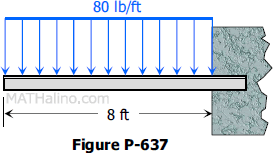
For the beam loaded as shown in Fig. P-637, determine the deflection 6 ft from the wall. Use E = 1.5 × 10⁶ psi and I = 40 in4.

The Cyclic Quadrilateral
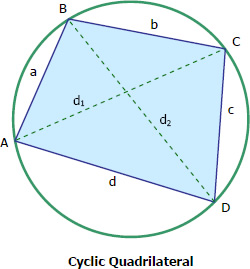
A quadrilateral is said to be cyclic if its vertices all lie on a circle. In cyclic quadrilateral, the sum of two opposite angles is 180° (or π radian); in other words, the two opposite angles are supplementary.
$B + D = 180^\circ$

- Read more about The Cyclic Quadrilateral
- Log in or register to post comments
The Quadrilateral
Quadrilateral is a polygon of four sides and four vertices. It is also called tetragon and quadrangle. In the triangle, the sum of the interior angles is 180°; for quadrilaterals the sum of the interior angles is always equal to 360°
Classifications of Quadrilaterals
There are two broad classifications of quadrilaterals; simple and complex. The sides of simple quadrilaterals do not cross each other while two sides of complex quadrilaterals cross each other.
Simple quadrilaterals are further classified into two: convex and concave. Convex if none of the sides pass through the quadrilateral when prolonged while concave if the prolongation of any one side will pass inside the quadrilateral.

- Read more about The Quadrilateral
- Log in or register to post comments
Solution to Problem 636 | Deflection of Cantilever Beams
Problem 636
The cantilever beam shown in Fig. P-636 has a rectangular cross-section 50 mm wide by h mm high. Find the height h if the maximum deflection is not to exceed 10 mm. Use E = 10 GPa.

Deflection of Cantilever Beams | Area-Moment Method
Generally, the tangential deviation t is not equal to the beam deflection. In cantilever beams, however, the tangent drawn to the elastic curve at the wall is horizontal and coincidence therefore with the neutral axis of the beam. The tangential deviation in this case is equal to the deflection of the beam as shown below.
- Read more about Deflection of Cantilever Beams | Area-Moment Method
- Log in or register to post comments


Recent comments
is it not…