
Problem 10 | Separation of Variables
Problem 10
$v (dv / dx) = g$, when $x = x_o$, $v = v_o$.
- Read more about Problem 10 | Separation of Variables
- Log in or register to post comments
Problem 10
$v (dv / dx) = g$, when $x = x_o$, $v = v_o$.
Problem 09
$(2a^2 - r^2) \, dr = r^3 \sin \theta \, d\theta$, when $\theta = 0$, $r = a$.
Solution 09
$\dfrac{(2a^2 - r^2) \, dr}{r^3} = \sin \theta \, d\theta$
Problem 07
$y' = x \exp (y - x^2)$, when $x = 0$, $y = 0$.
Solution 07
$\dfrac{dy}{dx} = x e^{y - x^2}$
Problem 05
$2y \, dx = 3x \, dy$, when $x = -2$, $y = 1$.
Solution 05
From Solution 04,
$\dfrac{x^2}{y^3} = c$
Problem 03
$xy \, y' = 1 + y^2$, when $x = 2$, $y = 3$.
Solution 03
$xy \, y' = 1 + y^2$
$xy \dfrac{dy}{dx} = 1 + y^2$
Problem 02
$2xy \, y' = 1 + y^2$, when $x = 2$, $y = 3$.
Solution 2
$2xy \, y' = 1 + y^2$
$2xy \dfrac{dy}{dx} = 1 + y^2$
Problem 04
$2y \, dx = 3x \, dy$, when $x = 2$, $y = 1$.
Solution 04
$2y \, dx = 3x \, dy$
$\dfrac{2y \, dx}{xy} = \dfrac{3x \, dy}{xy}$
Problem 340
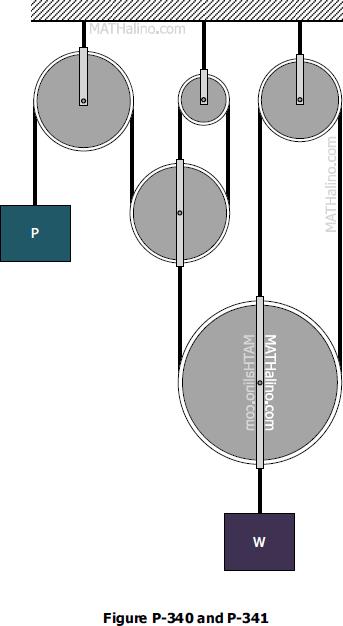
For the system of pulleys shown in Fig. P-340, determine the ratio of W to P to maintain equilibrium. Neglect axle friction and the weights of the pulleys.
Recent comments
is it not…