
Bolt Calculation
Can you help me to solve bolt calculate? how can I find document and exercises? Please help me.
- Read more about Bolt Calculation
- Log in or register to post comments
Can you help me to solve bolt calculate? how can I find document and exercises? Please help me.
Hello,
We should get the length x , when the grabber can just hold the box.

I made two moment equations:


Then I put them together into one equation: 
And from that equation I found out x: 
Good afternoon (from Europe) !
The given solution of mentioned problem is wrong.
There must be some initial velocity of particle "A" moving downwards along slope.
Particle "\"B\"": t_B=√(2h/g)
Particle "\"A\" ": L=v_(A,i) t+a t^2/2=v_(A,i) √(2h/g)+gsinα (√(2h/g))^2/2=v_(A,i) √(2h/g)+h^2/L
v_(A,i)=L(1-h^2/L^2 ) √(g/2h)=20*(1-〖12〗^2/〖20〗^2 ) √(9.81/(2*12))=8.18 m/s
The result meets our expectation.
Best regards !
congestus
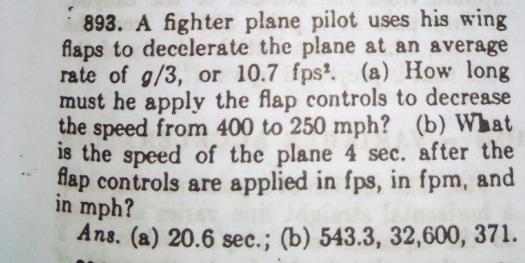
A balloon rises from the ground with a constant acceleration of 4ft per sec^2. Five seconds later, a stone is thrown vertically up from the launching site. What must be the minimum initial velocity of the stone for it to just touch the balloon? Note that the balloon and stone have the same velocity at contact.
Calculate the HP needed to transport a steel bucket weighing 66,759 kg supported a 703 meter stainless steel cable at a steep incline of 84 degrees.
The trip could not take more than 10 minutes.
Hello,
I am writing because I have a problem that I can not solve.
I would be thankul if someone could help me solve this problem.
The problem is as follows:
A simple supported right-angle triangle truss of 1/2( 5 x 12 ) meter square, is subjected with 50KN and 25KN at the mid-span and top end of the truss respectively. The truss is having two internal members one acting horizontal at the mid-span and the other acting diagonal from support A to joint at a point on the slanted side of right angle triangle.
Taking into account that the pined support is on the right and the roller on the left.
You are required to check the determinant and compute the reactions of this truss.
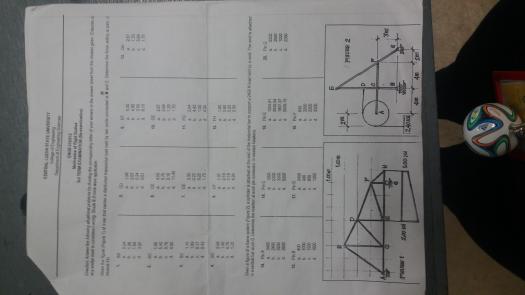
Please help me.
Please help. I can't find any solution of this problem on the internet. Thank you.
A glass falls from the window of a tall building . The sound of broken glass reaches the same level 3 s later. How high is the window? Assume velocity of sound to be 340m/s
 Forum posts (unless otherwise specified) licensed under a Creative Commons Licence.
Recent comments
is it not…