
Active forum topics
- Homework About Torsion
- Problems in progression
- Ceva’s Theorem Is More Than a Formula for Concurrency
- The Chain Rule Explained: Don't Just Memorize, Visualize It
- The Intuition Behind Integration by Parts (Proof & Example)
- Statics
- Calculus
- Hydraulics: Rotating Vessel
- Inverse Trigo
- Hydraulics: Water is flowing through a pipe
New forum topics
- Ceva’s Theorem Is More Than a Formula for Concurrency
- The Chain Rule Explained: Don't Just Memorize, Visualize It
- The Intuition Behind Integration by Parts (Proof & Example)
- Statics
- Calculus
- Hydraulics: Rotating Vessel
- Hydraulics: Water is flowing through a pipe
- Inverse Trigo
- Problems in progression
- General Solution of $y' = x \, \ln x$
Recent comments
- (a)
Max. shear at A = 12.73…2 weeks 1 day ago - mm equivalent of 6m3 months 2 weeks ago
- thankyouu!5 months 3 weeks ago
- z6 months ago
- Force P only impends motion…6 months ago
- Wow! :>6 months 2 weeks ago
- In general, the centroid of …6 months 3 weeks ago
- isn't the centroid of the…6 months 3 weeks ago
- I get it now, for long I was…7 months 1 week ago
- Why is BD Tension?
is it not…7 months 1 week ago

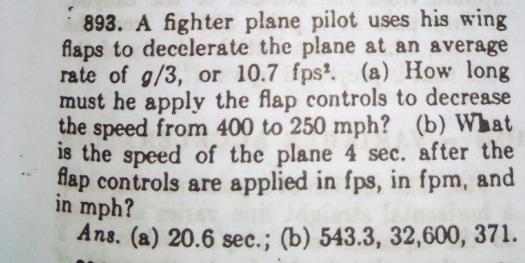
initial velocity, vo = 400
initial velocity, vo = 400 mph = 586.67 fps
Part (a); final velocity, v = 250 mph = 366.67 fps
$v = v_o + at$
$366.67 = 586.67 - 10.7t$
$t = 20.56 ~ \text{s}$ answer
Part (b); t = 4 s
$v = v_o + at$
$v = 586.67 - 10.7(4)$
$v = 543.87 ~ \text{fps} = 32\,632.2 ~ \text{fpm} = 370.82 ~ \text{mph}$ answer