
Solution to Problem 223 Triaxial Deformation
Problem 223
- Read more about Solution to Problem 223 Triaxial Deformation
- Log in or register to post comments
Problem 223
Problem 222
A solid cylinder of diameter d carries an axial load P. Show that its change in diameter is 4Pν / πEd.
Problem 219
A round bar of length L, which tapers uniformly from a diameter D at one end to a smaller diameter d at the other, is suspended vertically from the large end. If w is the weight per unit volume, find the elongation of ω the rod caused by its own weight. Use this result to determine the elongation of a cone suspended from its base.
Problem 218
A uniform slender rod of length L and cross sectional area A is rotating in a horizontal plane about a vertical axis through one end. If the unit mass of the rod is ρ, and it is rotating at a constant angular velocity of ω rad/sec, show that the total elongation of the rod is ρω2 L3/3E.
Problem 217
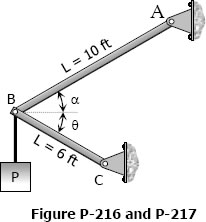
Solve Prob. 216 if rod AB is of steel, with E = 29 × 106 psi. Assume α = 45° and θ = 30°; all other data remain unchanged.
Problem 216
As shown in Fig. P-216, two aluminum rods AB and BC, hinged to rigid supports, are pinned together at B to carry a vertical load P = 6000 lb. If each rod has a cross-sectional area of 0.60 in.2 and E = 10 × 106 psi, compute the elongation of each rod and the horizontal and vertical displacements of point B. Assume α = 30° and θ = 30°.
Problem 215
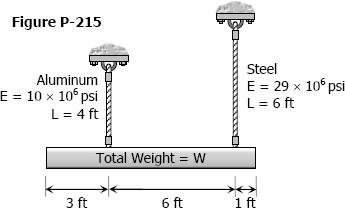
A uniform concrete slab of total weight W is to be attached, as shown in Fig. P-215, to two rods whose lower ends are on the same level. Determine the ratio of the areas of the rods so that the slab will remain level.
Solution 215
Problem 214
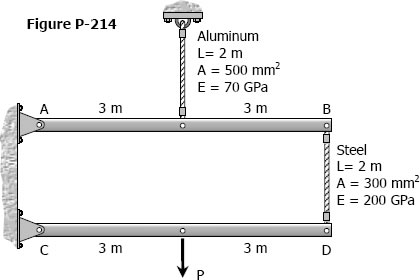
The rigid bars AB and CD shown in Fig. P-214 are supported by pins at A and C and the two rods. Determine the maximum force P that can be applied as shown if its vertical movement is limited to 5 mm. Neglect the weights of all members.
Problem 213
The rigid bar AB, attached to two vertical rods as shown in Fig. P-213, is horizontal before the load P is applied. Determine the vertical movement of P if its magnitude is 50 kN.

Problem 212
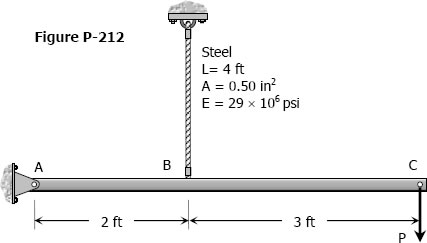
The rigid bar ABC shown in Fig. P-212 is hinged at A and supported by a steel rod at B. Determine the largest load P that can be applied at C if the stress in the steel rod is limited to 30 ksi and the vertical movement of end C must not exceed 0.10 in.
Recent comments
is it not…