
Derivation of the Double Angle Formulas
The Double Angle Formulas can be derived from Sum of Two Angles listed below:
$\sin (A + B) = \sin A \, \cos B + \cos A \, \sin B$ → Equation (1)
$\cos (A + B) = \cos A \, \cos B - \sin A \, \sin B$ → Equation (2)
$\tan (A + B) = \dfrac{\tan A + \tan B}{1 - \tan A \, \tan B}$ → Equation (3)
- Read more about Derivation of the Double Angle Formulas
- Log in or register to post comments
Solution to Problem 318 Torsion
Problem 318
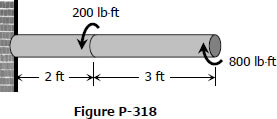
A solid aluminum shaft 2 in. in diameter is subjected to two torques as shown in Fig. P-318. Determine the maximum shearing stress in each segment and the angle of rotation of the free end. Use G = 4 × 10⁶ psi.
- Read more about Solution to Problem 318 Torsion
- 1 comment
- Log in or register to post comments
Solution to Problem 317 Torsion
Problem 317
A hollow bronze shaft of 3 in. outer diameter and 2 in. inner diameter is slipped over a solid steel shaft 2 in. in diameter and of the same length as the hollow shaft. The two shafts are then fastened rigidly together at their ends. For bronze, G = 6 × 10⁶ psi, and for steel, G = 12 × 106 psi. What torque can be applied to the composite shaft without exceeding a shearing stress of 8000 psi in the bronze or 12 ksi in the steel?
- Read more about Solution to Problem 317 Torsion
- 2 comments
- Log in or register to post comments
316 Permissible Torque That Can Be Applied to a Compound Shaft
Problem 316
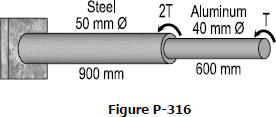
A compound shaft consisting of a steel segment and an aluminum segment is acted upon by two torques as shown in Fig. P-316. Determine the maximum permissible value of T subject to the following conditions: τst ≤ 83 MPa, τal ≤ 55 MPa, and the angle of rotation of the free end is limited to 6°. For steel, G = 83 GPa and for aluminum, G = 28 GPa.
315 Power Applied and Removed at Shaft Gears
Problem 315
A 5-m steel shaft rotating at 2 Hz has 70 kW applied at a gear that is 2 m from the left end where 20 kW are removed. At the right end, 30 kW are removed and another 20 kW leaves the shaft at 1.5 m from the right end. (a) Find the uniform shaft diameter so that the shearing stress will not exceed 60 MPa. (b) If a uniform shaft diameter of 100 mm is specified, determine the angle by which one end of the shaft lags behind the other end. Use G = 83 GPa.
- Read more about 315 Power Applied and Removed at Shaft Gears
- Log in or register to post comments
314 Maximum Shear and Relative Gear Rotation of a Compound Steel Shaft
Problem 314
The steel shaft shown in Fig. P-314 rotates at 4 Hz with 35 kW taken off at A, 20 kW removed at B, and 55 kW applied at C. Using G = 83 GPa, find the maximum shearing stress and the angle of rotation of gear A relative to gear C.
313 Maximum Torque That Can be Applied to a Hollow Steel Shaft
Problem 313
Determine the maximum torque that can be applied to a hollow circular steel shaft of 100-mm outside diameter and an 80-mm inside diameter without exceeding a shearing stress of 60 MPa or a twist of 0.5 deg/m. Use G = 83 GPa.
312 Deformation of Flexible Shaft Made From Steel Wire Encased in Stationary Tube
Problem 312
A flexible shaft consists of a 0.20-in-diameter steel wire encased in a stationary tube that fits closely enough to impose a frictional torque of 0.50 lb·in/in. Determine the maximum length of the shaft if the shearing stress is not to exceed 20 ksi. What will be the angular deformation of one end relative to the other end? G = 12 × 106 psi.
311 Aluminum Shaft Loaded by Multiple Torques Applied at Gears
Problem 311
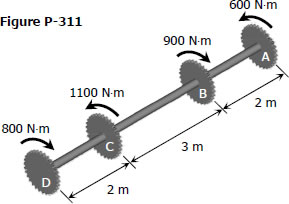
An aluminum shaft with a constant diameter of 50 mm is loaded by torques applied to gears attached to it as shown in Fig. P-311. Using G = 28 GPa, determine the relative angle of twist of gear D relative to gear A.
310 Strength Comparison of Hollow and Solid Steel Shafts of Equal Outside Diameters
Problem 310
Show that the hollow circular shaft whose inner diameter is half the outer diameter has a torsional strength equal to 15/16 of that of a solid shaft of the same outside diameter.
Recent comments
is it not…