
Solution to Problem 131 Bearing Stress
Problem 131
Repeat Problem 130 if the rivet diameter is 22 mm and all other data remain unchanged.
- Read more about Solution to Problem 131 Bearing Stress
- Log in or register to post comments
Problem 131
Repeat Problem 130 if the rivet diameter is 22 mm and all other data remain unchanged.
Problem 130
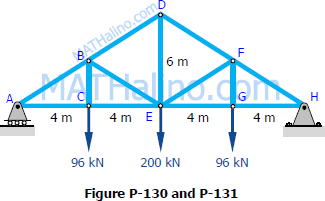
Figure P-130 shows a roof truss and the detail of the riveted connection at joint B. Using allowable stresses of τ = 70 MPa and σb= 140 MPa, how many 19-mm-diameter rivets are required to fasten member BC to the gusset plate? Member BE? What is the largest average tensile or compressive stress in BC and BE?
Problem 129
Problem 128
Problem 127
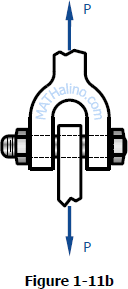
In the clevis shown in Fig. 1-11b, find the minimum bolt diameter and the minimum thickness of each yoke that will support a load P = 14 kips without exceeding a shearing stress of 12 ksi and a bearing stress of 20 ksi.
Problem 126
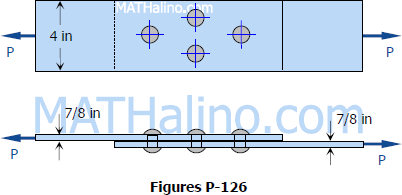
The lap joint shown in Fig. P-126 is fastened by four ¾-in.-diameter rivets. Calculate the maximum safe load P that can be applied if the shearing stress in the rivets is limited to 14 ksi and the bearing stress in the plates is limited to 18 ksi. Assume the applied load is uniformly distributed among the four rivets.
In Fig. 1-12, assume that a 20-mm-diameter rivet joins the plates that are each 110 mm wide. The allowable stresses are 120 MPa for bearing in the plate material and 60 MPa for shearing of rivet. Determine (a) the minimum thickness of each plate; and (b) the largest average tensile stress in the plates.
Problem 123
A rectangular piece of wood, 50 mm by 100 mm in cross section, is used as a compression block shown in Fig. P-123. Determine the axial force P that can be safely applied to the block if the compressive stress in wood is limited to 20 MN/m2 and the shearing stress parallel to the grain is limited to 5MN/m2. The grain makes an angle of 20° with the horizontal, as shown. (Hint: Use the results in Problem 122.)
Problem 122
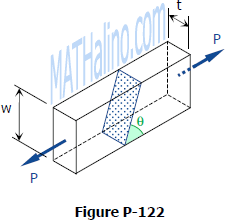
Two blocks of wood, width w and thickness t, are glued together along the joint inclined at the angle θ as shown in Fig. P-122. Using the free-body diagram concept in Fig. 1-4a, show that the shearing stress on the glued joint is τ = P sin 2θ / 2A, where A is the cross-sectional area.
Problem 121
Referring to Fig. P-121, compute the maximum force P that can be applied by the machine operator, if the shearing stress in the pin at B and the axial stress in the control rod at C are limited to 4000 psi and 5000 psi, respectively. The diameters are 0.25 inch for the pin, and 0.5 inch for the control rod. Assume single shear for the pin at B.
Recent comments
is it not…