HomeMATHalinoEngineering Math Review
  • Home
    • Recent
    • Glossary
    • About
  • Algebra
    • Derivation of Formulas
    • Engineering Economy
    • General Engineering
  • Trigo
    • Spherical Trigonometry
  • Geometry
    • Solid Geometry
    • Analytic Geometry
  • Calculus
    • Integral Calculus
    • Differential Equations
    • Advance Engineering Mathematics
  • Mechanics
    • Strength of Materials
    • Structural Analysis
  • CE
    • CE Board: Math
    • CE Board: Hydro Geo
    • CE Board: Design
    • Surveying
    • Hydraulics
    • Timber Design
    • Reinforced Concrete
    • Geotechnical Engineering
  • Courses
    • Exams
    • Old MCQ
  • Forums
    • Basic Engineering Math
    • Calculus
    • Mechanics
    • General Discussions
  • Blogs

Breadcrumbs

You are here:

  1. Home
  2. overhanging beam

overhanging beam

Problem 840 | Continuous Beams with Fixed Ends

Problem 840
For the propped beam shown in Fig. P-840, determine the prop reaction and the maximum positive bending moment.
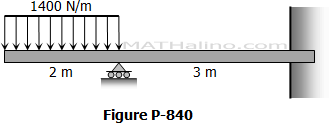
 

840-propped-beam-with-overhang.gif


  • Read more about Problem 840 | Continuous Beams with Fixed Ends
  • Log in to post comments

Continuous Beams with Fixed Ends

Problem 839
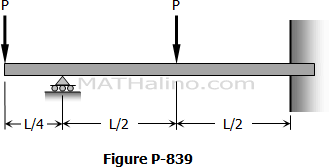
Determine the prop reaction for the beam in Fig. P-839.
 

839-propped-beam-with-overhang.gif


  • Read more about Continuous Beams with Fixed Ends
  • Log in to post comments

Problem 836 | Reactions of Continuous Beams

Problem 836
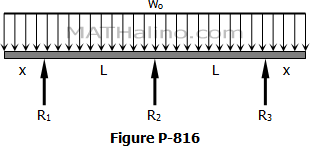
For the continuous beam loaded as shown in Fig. P-816, determine the length x of the overhang that will cause equal reactions.
 

816-equal-moments-over-supports.gif


  • Read more about Problem 836 | Reactions of Continuous Beams
  • Log in to post comments

Problem 816 | Continuous Beam by Three-Moment Equation

Problem 816
Determine the lengths of the overhangs in Fig. P-816 so that the moments over the supports will be equal
 

816-equal-moments-over-supports.gif


  • Read more about Problem 816 | Continuous Beam by Three-Moment Equation
  • Log in to post comments

Solution to Problem 696-697 | Beam Deflection by Method of Superposition

Problem 696
In Fig. P-696, determine the value of P for which the deflection under P will be zero.
 

  • Read more about Solution to Problem 696-697 | Beam Deflection by Method of Superposition
  • Log in to post comments

Solution to Problem 693 | Beam Deflection by Method of Superposition

Problem 693
Determine the value of EIδ at the left end of the overhanging beam in Fig. P-693.
 

  • Read more about Solution to Problem 693 | Beam Deflection by Method of Superposition
  • Log in to post comments

Solution to Problem 692 | Beam Deflection by Method of Superposition

Problem 692
Find the value of EIδ midway between the supports for the beam shown in Fig. P-692. (Hint: Combine Case No. 11 and one half of Case No. 8.)
 

  • Read more about Solution to Problem 692 | Beam Deflection by Method of Superposition
  • Log in to post comments

Solution to Problem 689 | Beam Deflection by Method of Superposition

Problem 689
The beam shown in Fig. P-689 has a rectangular cross section 4 inches wide by 8 inches deep. Compute the value of P that will limit the midspan deflection to 0.5 inch. Use E = 1.5 × 10⁶ psi.

  • Read more about Solution to Problem 689 | Beam Deflection by Method of Superposition
  • Log in to post comments

Solution to Problem 688 | Beam Deflection by Method of Superposition

Problem 688
Determine the midspan value of EIδ at the left end of the beam shown in Fig. P-688.
 

  • Read more about Solution to Problem 688 | Beam Deflection by Method of Superposition
  • Log in to post comments

Solution to Problem 675 | Midspan Deflection

Problem 675
Repeat Prob. 674 for the overhanging beam shown in Fig. P-675.
 

  • Read more about Solution to Problem 675 | Midspan Deflection
  • Log in to post comments

Pagination

  • Previous page ‹‹
  • (Page 2)
  • Next page ››
Home • Forums • Blogs • Glossary • Recent
About • Contact us • Terms of Use • Privacy Policy • Hosted by Linode • Powered by Drupal
MATHalino - Engineering Mathematics • Copyright 2025 Jhun Vert • All rights reserved