
Active forum topics
- Homework About Torsion
- Problems in progression
- Ceva’s Theorem Is More Than a Formula for Concurrency
- The Chain Rule Explained: Don't Just Memorize, Visualize It
- The Intuition Behind Integration by Parts (Proof & Example)
- Statics
- Calculus
- Hydraulics: Rotating Vessel
- Inverse Trigo
- Hydraulics: Water is flowing through a pipe
New forum topics
- Ceva’s Theorem Is More Than a Formula for Concurrency
- The Chain Rule Explained: Don't Just Memorize, Visualize It
- The Intuition Behind Integration by Parts (Proof & Example)
- Statics
- Calculus
- Hydraulics: Rotating Vessel
- Hydraulics: Water is flowing through a pipe
- Inverse Trigo
- Problems in progression
- General Solution of $y' = x \, \ln x$
Recent comments
- (a)
Max. shear at A = 12.73…2 weeks 3 days ago - mm equivalent of 6m3 months 3 weeks ago
- thankyouu!5 months 3 weeks ago
- z6 months ago
- Force P only impends motion…6 months ago
- Wow! :>6 months 3 weeks ago
- In general, the centroid of …6 months 3 weeks ago
- isn't the centroid of the…6 months 3 weeks ago
- I get it now, for long I was…7 months 1 week ago
- Why is BD Tension?
is it not…7 months 1 week ago

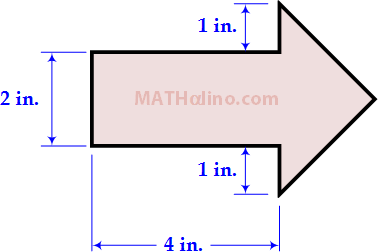
The Total Area of Arrow
The Total Area of Arrow Polygon= Area of Rectangle + Area of Right Triangle or Isosceles Right Triangle.
Since the vertex angle at the tip of the arrow is 90 degrees by inspection the triangle is isosceles triangle in which two sides are equal, We all know that the total interior angles of a triangle is equal to 180 degrees, thus the two remaining angles are 45 degrees each.Here i divided the triangle into two equal parts from the end side midpoint of a rectangle vertically and horizontally to the vertex with two sides at 2 inches each which is also a right triangle or isosceles right triangle.
Total Area of the Arrow polygon would be=( 2 x 4) + 2 ((1/2) (2)(2))
Total Area of the Arrow Polygon= 8 + 4 = 12 sq. in Ans.