
Problem 17 | Separation of Variables
Problem 17
$\dfrac{dV}{dP} = -\dfrac{V}{P}$
- Read more about Problem 17 | Separation of Variables
- Log in or register to post comments
Problem 16 | Separation of Variables
Problem 16
$y' = xy^2$
Solution 16
Click here to expand or collapse this section
$y' = xy^2$
$\dfrac{dy}{dx} = xy^2$
- Read more about Problem 16 | Separation of Variables
- Log in or register to post comments
Problem 13 | Separation of Variables
Problem 13
$xy^3 \, dx + e^{x^2} \, dy = 0$
- Read more about Problem 13 | Separation of Variables
- Log in or register to post comments
Problem 343 | Equilibrium of Parallel Force System
Problem 343
The weight W of a traveling crane is 20 tons acting as shown in Fig. P-343. To prevent the crane from tipping to the right when carrying a load P of 20 tons, a counterweight Q is used. Determine the value and position of Q so that the crane will remain in equilibrium both when the maximum load P is applied and when the load P is removed.
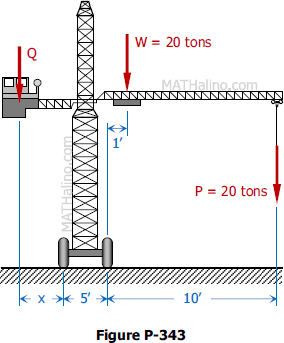
- Read more about Problem 343 | Equilibrium of Parallel Force System
- Log in or register to post comments
Problem 342 | Equilibrium of Parallel Force System
Problem 342
The wheel loads on a jeep are given in Fig. P-342. Determine the distance x so that the reaction of the beam at A is twice as great as the reaction at B.
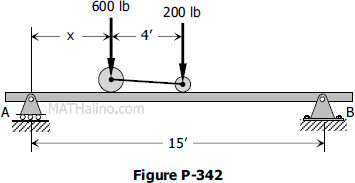
- Read more about Problem 342 | Equilibrium of Parallel Force System
- Log in or register to post comments
Problem 11 | Separation of Variables
Problem 11
$(1 - x)y' = y^2$
Solution 11
Click here to expand or collapse this section
$(1 - x)y' = y^2$
- Read more about Problem 11 | Separation of Variables
- Log in or register to post comments
Recent comments
is it not…