
The Chain Rule Explained: Don't Just Memorize, Visualize It
Many students struggle with the Chain Rule because they get lost in the notation of f(g(x)) and dy/dx = (dy/du) * (du/dx). Let's break down what it actually means in plain English.
Many students struggle with the Chain Rule because they get lost in the notation of f(g(x)) and dy/dx = (dy/du) * (du/dx). Let's break down what it actually means in plain English.
Many students simply memorize the Integration by Parts formula: ∫ u dv = uv - ∫ v du, but understanding where it comes from makes it much easier to remember and apply during exams.
The entire concept is actually just the Product Rule for differentiation in reverse.
From the product rule for two differentiable functions, u and v: (uv)' = u'v + uv'
Hello, can anyone solve this equation?
I can't figure it out,
$(1-xy)^{-2} dx + \left[ y^2 + x^2 (1-xy)^{-2} \right] dy = 0$
Thanks.
Can anyone solve this D. E.?
y' = x^3 - 2xy, where y(1)=1
and
y' = 2(2x-y) that passes through (0,1)
Hi! I need help with these.
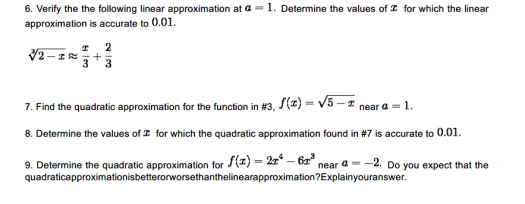
Help me find the limits of these:
Help me identify all asymptotes and the end behavior of the graph:
Find the diff equation of family of circles with center on the line y= -x and passing through the origin.
THANK YOU :)
The radial stress p at distance r for the axis of the thick cylinder subjected to internal pressure is given by p + r (dp/dr) = A − p where A is a constant. If p = p0 at the inner wall r = r1 and is negligible (p = 0) at the outer wall r = r2 find an expression for p.
kindly help me with my homework. eliminate the following arbitrary constants...
y= x^2 + c1 e^3x + c2 e^3x.