Ceva’s Theorem Is More Than a Formula for Concurrency

In triangle geometry, one of the most efficient ways to test whether three cevians are concurrent is Ceva’s Theorem.

Let D, E, F lie on sides BC, CA, AB respectively of triangle ABC. Then lines AD, BE, and CF are concurrent if and only if

(BD/DC) * (CE/EA) * (AF/FB) = 1.

What I find interesting is that many students learn this as a “contest trick,” but it is actually a very natural statement. The theorem says that concurrency is encoded by a balance condition on the three side partitions.

Area of a triangle

In square $ABCD$, $E$ is the midpoint of side $\overline{AB}$ and $F$ is a point of side $\overline{AD}$ such that $F$ is twice as near from $D$ as from $A$. $G$ is the intersection of the line segments $\overline{DE}$ and $\overline{CF}$. If $AB = 1\text{ cm}$, find the area of $\triangle CDG$.

There are several ways to solve this problem, please show your solutions.

Solid Geometry

A regular octagon has one of its sides equal to 12 cm. if a square, which is inscribed in the octagon, is being cut out, determine the percentage of waste due to this process.

Can you help me on this po sir? I cant really figure what happened to the square.. Thanks a lot po .. Godbless!

Solid mensuration

Good day sir!
"A frustum of a regular pyramid has a lower base of 12cm by 12cm and an upper base of 8cm by 8cm. If the lateral edge is 18cm, compute the volume of the regular pyramid."

The answer is V=1801.71cm3 which is actually the volume of the frustum. Is he correct sir? Because i was thinking i should get the whole volume of the square based regular pyramid.

Circles

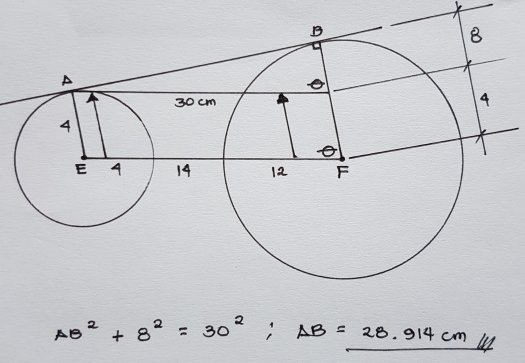
Two circles have radius of 4cm. and 12cm. respectively. If the distance between their centers is 30cm., compute the length of the common external tangent to the two circles on one side only.
It says the answer is 31.05cm.

The following image is my solution but as you can see i got 28.914cm. Please help me. I cant seem to find where did i make a mistake. Thanks a ton sir!

20190728_161647.jpg

Circle

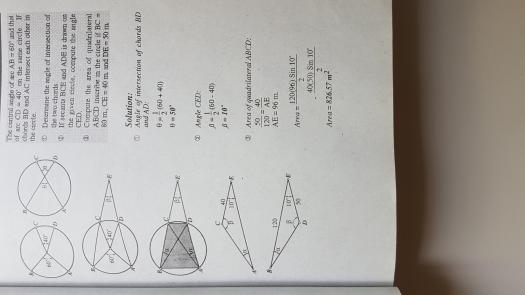
Good day po sir! Is the angle of intersection between two chords of a circle equal to one of the vertical angles of the cyclic quadrilateral that is formed by this chords? Im so confused. Please help. Below is the problem followed with my progression. Thanks a ton!
20190727_131259.jpg

Decimal Fractional Parts of Segment Dim's on Hypotenuses of Dissimilar Right Triangles

DECIMAL FRACTIONS:
The decimal, fractional part of a positive real number is the excess beyond that number's integer part; e.g., for the number 3.75, the numbers to the right of the decimal point make up the decimal, fractional part of the positive real number 3. The decimal fractional part, .75 equals the fraction 3/4.

For sources, see links below;

https://en.wikipedia.org/wiki/Decimal?wprov=sfla1.

Product of Areas of Three Dissimilar Right Triangles

The formula below will find the product P for the areas of 3 right triangles A, B & C, as described in Geometry Post, Three Dissimilar Right Triangles.

P = (ab)^4 / 2c^2

1. Triangle C is a known right triangle, with legs "a" & "b", and hypotenuse "c".

2. a is the short leg and b is the long leg of C

3. Hypotenuse of A = 2(b) of C.

4. Hypotenuse of B = 2(a) of C.

5. Altitudes to hypotenuse in A & B
are identical to that in C.