
Active forum topics
- Homework About Torsion
- Problems in progression
- Ceva’s Theorem Is More Than a Formula for Concurrency
- The Chain Rule Explained: Don't Just Memorize, Visualize It
- The Intuition Behind Integration by Parts (Proof & Example)
- Statics
- Calculus
- Hydraulics: Rotating Vessel
- Inverse Trigo
- Hydraulics: Water is flowing through a pipe
New forum topics
- Ceva’s Theorem Is More Than a Formula for Concurrency
- The Chain Rule Explained: Don't Just Memorize, Visualize It
- The Intuition Behind Integration by Parts (Proof & Example)
- Statics
- Calculus
- Hydraulics: Rotating Vessel
- Hydraulics: Water is flowing through a pipe
- Inverse Trigo
- Problems in progression
- General Solution of $y' = x \, \ln x$
Recent comments
- (a)
Max. shear at A = 12.73…2 weeks 3 days ago - mm equivalent of 6m3 months 3 weeks ago
- thankyouu!5 months 3 weeks ago
- z6 months ago
- Force P only impends motion…6 months ago
- Wow! :>6 months 3 weeks ago
- In general, the centroid of …6 months 3 weeks ago
- isn't the centroid of the…6 months 3 weeks ago
- I get it now, for long I was…7 months 1 week ago
- Why is BD Tension?
is it not…7 months 1 week ago

Differential Equation:
Differential Equation: Application of D.E: Exponential Decay
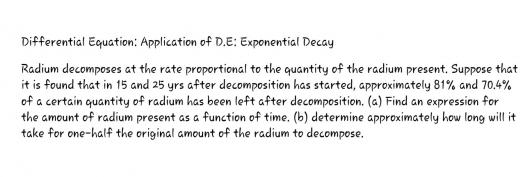
Radium decomposes at the rate proportional to the quantity of the radium present. Suppose that it is found that in 15 and 25 yrs after decomposition has started, approximately 81% and 70.4% of a certain quantity of radium has been left after decomposition. (a) Find an expression for the amount of radium present as a function of time. (b) determine approximately how long will it take for one-half the original amount of the radium to decompose.
Let x = amount of radium at
Let x = amount of radium at any time.
$\dfrac{dx}{dt} = kt$
$\dfrac{dx}{x} = k \, dt$
$\displaystyle \int \dfrac{dx}{x} = k \int dt$
$\ln x = kt + c$
When t = 15 yrs, x = 81%
$\ln 81 = 15k + c$ ← (1)
When t = 25, x = 70.4%
$\ln 70.4 = 25k + c$ ← (2)
From (1) and (2)
$k = -0.014$
$c = 4.605$
Hence,
$\ln x = -0.014t + 4.605$ answer for part (a)
$t = \dfrac{4.605 - \ln x}{0.014}$
For x = 50%
$t = \dfrac{4.605 - \ln 50}{0.014}$
$t = 49.5 ~ \text{years}$ answer for part (b)
Another solution (By
Another solution (By Calculator - CASIO fx-991ES PLUS):
MODE 3 5
AC
$t = 50\hat{x} = 59.4 ~ \text{years}$
Note:
$\hat{x}$ = SHIFT 1 5 4