Moving Loads
Moving Loads
From the previous section, we see that the maximum moment occurs at a point of zero shears. For beams loaded with concentrated loads, the point of zero shears usually occurs under a concentrated load and so the maximum moment.
Beams and girders such as in a bridge or an overhead crane are subject to moving concentrated loads, which are at fixed distance with each other. The problem here is to determine the moment under each load when each load is in a position to cause a maximum moment. The largest value of these moments governs the design of the beam.
Single Moving Load
For a single moving load, the maximum moment occurs when the load is at the midspan and the maximum shear occurs when the load is very near the support (usually assumed to lie over the support).

Two Moving Loads
For two moving loads, the maximum shear occurs at the reaction when the larger load is over that support. The maximum moment is given by

where Ps is the smaller load, Pb is the bigger load, and P is the total load (P = Ps + Pb).
Three or more moving loads
In general, the bending moment under a particular load is a maximum when the center of the beam is midway between that load and the resultant of all the loads then on the span. With this rule, we compute the maximum moment under each load, and use the biggest of the moments for the design. Usually, the biggest of these moments occurs under the biggest load.
The maximum shear occurs at the reaction where the resultant load is nearest. Usually, it happens if the biggest load is over that support and as many a possible of the remaining loads are still on the span.
In determining the largest moment and shear, it is sometimes necessary to check the condition when the bigger loads are on the span and the rest of the smaller loads are outside.
Solution to Problem 453 | Moving Loads
Problem 453
A truck with axle loads of 40 kN and 60 kN on a wheel base of 5 m rolls across a 10-m span. Compute the maximum bending moment and the maximum shearing force.
Solution 453
Click here to expand or collapse this section
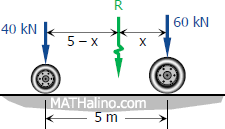 $R = 40 + 60 = 100 \, \text{kN}$
$xR = 40(5)$
$x = 200/R$
$x = 200/100$
$x = 2 \, \text{m}$
For maximum moment under 40 kN wheel:
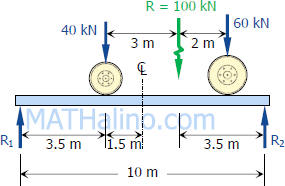 $\Sigma M_{R2} = 0$
$10R_1 = 3.5(100)$
$R_1 = 35 \, \text{kN}$
$M_{To\,\,the\,\,left\,\,of\,\,40\,\,kN} = 3.5R_1$
$M_{To\,\,the\,\,left\,\,of\,\,40\,\,kN} = 3.5(35)$
$M_{To\,\,the\,\,left\,\,of\,\,40\,\,kN} = 122.5 \, \text{kN}\cdot\text{m}$
For maximum moment under 60 kN wheel:
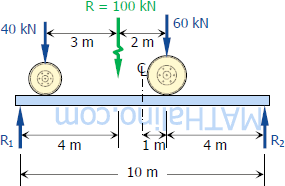 $\Sigma M_{R1} = 0$
$10R_2 = 4(100)$
$R_2 = 40 \, \text{kN}$
$M_{To\,\,the\,\,right\,\,of\,\,60\,\,kN} = 4R_2$
$M_{To\,\,the\,\,right\,\,of\,\,60\,\,kN} = 4(40)$
$M_{To\,\,the\,\,right\,\,of\,\,60\,\,kN} = 160 \, \text{kN}\cdot\text{m}$
Thus, $M_{max} = 160 \, \text{kN}\cdot\text{m} \,\, $ answer
The maximum shear will occur when the 60 kN is over a support.
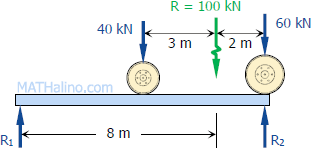 $\Sigma M_{R1} = 0$
$10R_2 = 100(8)$
$R_2 = 80 \, \text{kN}$
Thus, $V_{max} = 80 \, \text{kN} \,\, $ answer
Solution to Problem 454 | Moving Loads
Problem 454
Repeat Prob. 453 using axle loads of 30 kN and 50 kN on a wheel base of 4 m crossing an 8-m span.
Solution 454
Click here to expand or collapse this section
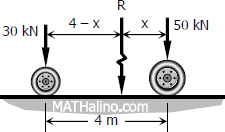 $R = 30 + 50 = 80 \, \text{kN}$
$xR = 4(30)$
$x = 120/R$
$x = 120/80$
$x = 1.5 \, \text{m}$
Maximum moment under 30 kN wheel:
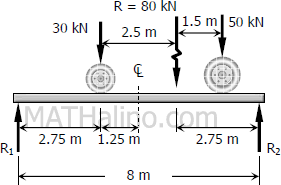 $\Sigma M_{R2} = 0$
$8R_1 = 2.75(80)$
$R_1 = 27.5 \, \text{kN}$
$M_{To\,\,the\,\,left\,\,of\,\,30\,\,kN} = 2.75R_1$
$M_{To\,\,the\,\,left\,\,of\,\,30\,\,kN} = 2.75(27.5)$
$M_{To\,\,the\,\,left\,\,of\,\,30\,\,kN} = 75.625 \, \text{kN}\cdot\text{m}$
Maximum moment under 50 kN wheel:
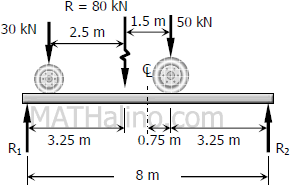 $\Sigma M_{R1} = 0$
$8R_2 = 3.25(80)$
$R_2 = 32.5 \, \text{kN}$
$M_{To\,\,the\,\,right\,\,of\,\,50\,\,kN} = 3.25R_2$
$M_{To\,\,the\,\,right\,\,of\,\,50\,\,kN} = 3.25(32.5)$
$M_{To\,\,the\,\,right\,\,of\,\,50\,\,kN} = 105.625 \, \text{kN}\cdot\text{m}$
Thus, $M_{max} = 105.625 \, \text{kN}\cdot\text{m}$ answer
The maximum shear will occur when the 50 kN is over a support.
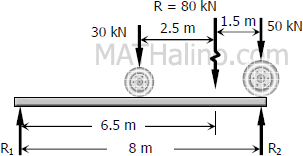 $\Sigma M_{R1} = 0$
$8R_2 = 6.5(80)$
$R_2 = 65 \, \text{kN}$
Thus, $V_{max} = 65 \, \text{kN} \,\,$ answer
Solution to Problem 455 | Moving Loads
Problem 455
A tractor weighing 3000 lb, with a wheel base of 9 ft, carries 1800 lb of its load on the rear wheels. Compute the maximum moment and maximum shear when crossing a 14 ft-span.
Solution 455
Click here to expand or collapse this section
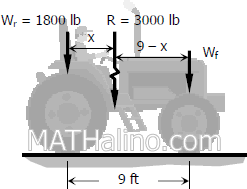 $R = W_r + W_f$
$3000 = 1800 + W_f$
$W_f = 1200 \, \text{lb}$
$Rx = 9W_f$
$3000x = 9(1200)$
$x = 3.6 \, \text{ft}$
$9 - x = 5.4 \, \text{ft}$
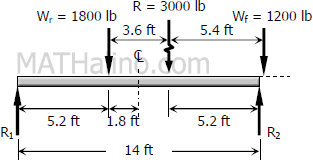 When the midspan is midway between Wr and R, the front wheel Wf will be outside the span (see figure). In this case, only the rear wheel Wr = 1800 lb is the load. The maximum moment for this condition is when the load is at the midspan.
$R_1 = R_2 = \frac{1}{2}(1800)$
$R_1 = 900 \, \text{lb}$
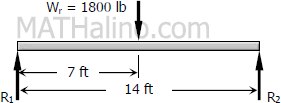 Maximum moment under Wr
$M_{To\,\,the\,\,left\,\,of\,\,rear\,\,wheel} = 7R_1$
$M_{To\,\,the\,\,left\,\,of\,\,rear\,\,wheel} = 7(900)$
$M_{To\,\,the\,\,left\,\,of\,\,rear\,\,wheel} = 6300 \, \text{lb}\cdot\text{ft}$
Maximum moment under Wf
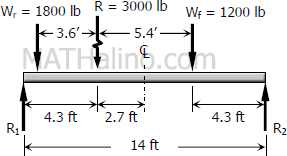 $\Sigma M_{R1} = 0$
$14R_2 = 4.3R$
$14R_2 = 4.3(3000)$
$R_2 = 921.43 \, \text{lb}$
$M_{To\,\,the\,\,right\,\,of\,\,front\,\,wheel} = 4.3R_2$
$M_{To\,\,the\,\,right\,\,of\,\,front\,\,wheel} = 4.3(921.43)$
$M_{To\,\,the\,\,right\,\,of\,\,front\,\,wheel} = 3962.1 \, \text{lb}\cdot\text{ft}$
Thus,
$M_{max} = M_{To\,\,the\,\,left\,\,of\,\,rear\,\,wheel}$
$M_{max} = 6300 \, \text{lb}\cdot\text{ft} \,\,$ answer
The maximum shear will occur when the rear wheel (wheel of greater load) is directly over the support.
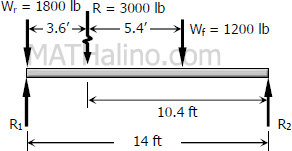 $\Sigma M_{R2} = 0$
$14R_1 = 10.4R$
$14R_1 = 10.4(3000)$
$R_1 = 2228.57 \, \text{lb}$
Thus,
$V_{max} = 2228.57 \, \text{lb} \,\,$ answer
Solution to Problem 456 | Moving Loads
Problem 456
Three wheel loads roll as a unit across a 44-ft span. The loads are P1 = 4000 lb and P2 = 8000 lb separated by 9 ft, and P3 = 6000 lb at 18 ft from P2. Determine the maximum moment and maximum shear in the simply supported span.
Solution 456
Click here to expand or collapse this section
$R = P_1 + P_2+ P_3$
$R = 4^k + 8^k + 6^k$
$R = 18 \, \text{kips}$
$R = 18,000 \, \text{lbs}$

$xR = 9P_2 + (9 + 18)P_3$
$x(18) = 9(8) + (9 + 18)(6)$
$x = 13 \, \text{ft} \,\,$ the resultant R is 13 ft from P1
Maximum moment under P1
$\Sigma M_{R2} = 0$
$44R_1 = 15.5R$
$44R_1 = 15.5(18)$
$R_1 = 6.34091 \, \text{kips}$
$R_1 = 6,340.91 \, \text{lbs}$

$M_{To\,\,the\,\,left\,\,of\,\,P_1} = 15.5R_1$
$M_{To\,\,the\,\,left\,\,of\,\,P_1} = 15.5(6340.91)$
$M_{To\,\,the\,\,left\,\,of\,\,P_1} = 98,284.1 \, \text{lb}\cdot\text{ft}$
Maximum moment under P2
$\Sigma M_{R2} = 0$
$44R_1 = 20R$
$44R_1 = 20(18)$
$R_1 = 8.18182 \, \text{kips}$
$R_1 = 8,181.82 \, \text{lbs}$

$M_{To\,\,the\,\,left\,\,of\,\,P_2} = 20R_1 - 9P_1$
$M_{To\,\,the\,\,left\,\,of\,\,P_2} = 20(8181.82) - 9(4000)$
$M_{To\,\,the\,\,left\,\,of\,\,P_2} = 127,636.4 \, \text{lb}\cdot\text{ft}$
Maximum moment under P3
$\Sigma R_1 = 0$
$44R_2 = 15R$
$44R_2 = 15(18)$
$R_2 = 6.13636 \, \text{kips}$
$R_2 = 6,136.36 \, \text{lbs}$

$M_{To\,\,the\,\,right\,\,of\,\,P_3} = 15R_2$
$M_{To\,\,the\,\,right\,\,of\,\,P_3} = 15(6,136.36)$
$M_{To\,\,the\,\,right\,\,of\,\,P_3} = 92,045.4 \, \text{lb}\cdot\text{ft}$
Thus,
$M_{max} = M_{To\,\,the\,\,left\,\,of\,\,P_2}$
$M_{max} = 127,636.4 \, \text{lb}\cdot\text{ft} \,\,$ answer
The maximum shear will occur when P1 is over the support.
$\Sigma M_{R2} = 0$
$44R_1 = 31R$
$44R_1 = 31(18)$
$R_1 = 12.6818 \, \text{kips}$
$R_1 = 12,681.8 \, \text{lbs}$

Thus, $V_{max} = 12,681.8 \, \text{lbs} \,\,$ answer
Solution to Problem 457 | Moving Loads
Problem 457
A truck and trailer combination crossing a 12-m span has axle loads of 10, 20, and 30 kN separated respectively by distances of 3 and 5 m. Compute the maximum moment and maximum shear developed in the span.
Solution 457
Click here to expand or collapse this section
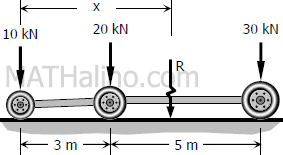 $R = 10 + 20 + 30$
$R = 60 \, \text{kN}$
$xR = 3(20) + 8(30)$
$x(60) = 3(20) + 8(30)$
$x = 5 \, \text{m}$
Maximum moment under 10 kN wheel load
$\Sigma M_{R2} = 0$
$12R_1 = 3.5R$
$12R_1 = 3.5(60)$
$12R_1 = 210$
$R_1 = 17.5 \, \text{kN}$

$M_{To\,the\,left\,of\,10\,kN} = 3.5R_1$
$M_{To\,the\,left\,of\,10\,kN} = 3.5(17.5)$
$M_{To\,the\,left\,of\,10\,kN} = 61.25 \, \text{kN}\cdot\text{m}$
Maximum moment under 20 kN wheel load
$\Sigma M_{R2} = 0$
$12R_1 = 5R$
$12R_1 = 5(60)$
$R_1 = 25 \, \text{kN}$

$M_{To\,the\,left\,of\,20\,kN} = 5R_1 - 3(10)$
$M_{To\,the\,left\,of\,20\,kN} = 5(25) - 30$
$M_{To\,the\,left\,of\,20\,kN} = 95 \text{kN}\cdot\text{m}$
Maximum moment under 30 kN wheel load
When the centerline of the beam is midway between reaction R = 60 kN and 30 kN, the 10 kN comes off the span.
$R = 20 + 30$
$R = 50 \, \text{kN}$
$xR = 5(30)$
$x(50) = 150$
$x = 3 \, \text{m} \,\,$ from 20 kN wheel load

$\Sigma M_{R1} = 0$
$12R_2 = 5R$
$12R_2 = 5(50)$
$R_2 = 20.83 \, \text{kN}$
$M_{To\,\,the\,\,right\,\,of\,\,30\,\,kN} = 5R_2$
$M_{To\,\,the\,\,right\,\,of\,\,30\,\,kN} = 5(20.83)$
$M_{To\,\,the\,\,right\,\,of\,\,30\,\,kN} = 104.17 \, \text{kN}\cdot\text{m}$
Thus, the maximum moment will occur when only the 20 and 30 kN loads are on the span.
$M_{max} = M_{To\,\,the\,\,right\,\,of\,\,30\,\,kN}$
$M_{max} = 104.17 \, \text{ kN}\cdot\text{m}$ answer
Maximum Shear
The maximum shear will occur when the three loads are on the span and the 30 kN load is directly over the support.
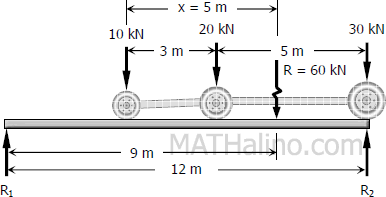 $\Sigma M_{R1} = 0$
$12R_2 = 9R$
$12R_2 = 9(60)$
$R_2 = 45 \, \text{kN}$
Thus,
$V_{max} = 45 \, \text{ kN}$ answer