Resultant of Concurrent Force System
Resultant of a force system is a force or a couple that will have the same effect to the body, both in translation and rotation, if all the forces are removed and replaced by the resultant.
The equation involving the resultant of force system are the following
- $R_x = \Sigma F_x = F_{x1} + F_{x2} + F_{x3} + ...$
The x-component of the resultant is equal to the summation of forces in the x-direction. - $R_y = \Sigma F_y = F_{x1} + F_{x2} + F_{x3} + ...$
The y-component of the resultant is equal to the summation of forces in the y-direction. - $R_z = \Sigma F_z = F_{x1} + F_{x2} + F_{x3} + ...$
The z-component of the resultant is equal to the summation of forces in the z-direction.
Note that according to the type of force system, one or two or three of the equations above will be used in finding the resultant.
Resultant of Coplanar Concurrent Force System
The line of action of each forces in coplanar concurrent force system are on the same plane. All of these forces meet at a common point, thus concurrent. In x-y plane, the resultant can be found by the following formulas:
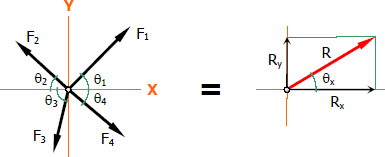
$R_y = \Sigma F_y$
$R = \sqrt{{R_x}^2 + {R_y}^2}$
$\tan \theta_x = \dfrac{R_y}{R_x}$
Resultant of Spatial Concurrent Force System
Spatial concurrent forces (forces in 3-dimensional space) meet at a common point but do not lie in a single plane. The resultant can be found as follows:
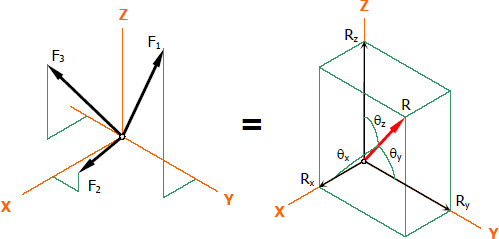
$R_y = \Sigma F_y$
$R_z = \Sigma F_z$
$R = \sqrt{{R_x}^2 + {R_y}^2 + {R_z}^2}$
Direction Cosines
$\cos \theta_y = \dfrac{R_y}{R}$
$\cos \theta_z = \dfrac{R_z}{R}$
Vector Notation of the Resultant
${\bf R} = \Sigma {\bf F}$
${\bf R} = (\Sigma F_x) {\bf i} + (\Sigma F_y) {\bf j} + (\Sigma F_z) {\bf k}$
Where
$R_x = \Sigma F_x$
$R_y = \Sigma F_y$
$R_z = \Sigma F_z$
$R = \sqrt{{R_x}^2 + {R_y}^2 + {R_z}^2}$
011 Resultant of three forces acting in a ring
Problem 011
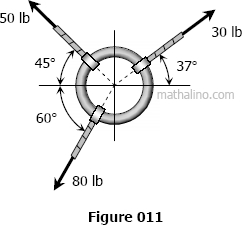
Three ropes are tied to a small metal ring. At the end of each rope three students are pulling, each trying to move the ring in their direction. If we look down from above, the forces and directions they are applying are shown in Fig. P-011. Find the net force on the ring due to the three applied forces.
Solution 011
Click here to expand or collapse this section
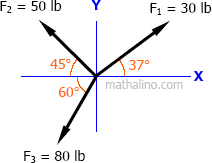 $R_x = \Sigma F_x$
$R_x = 30 \cos 37^\circ - 50 \cos 45^\circ - 80 \cos 60^\circ$
$R_x = -51.40 \, \text{ lb}$
$R_x = 51.40 \, \text{ lb to the left}$
$R_y = \Sigma F_y$
$R_y = 30 \sin 37^\circ + 50 \sin 45^\circ - 80 \sin 60^\circ$
$R_y = -15.87 \, \text{ lb}$
$R_y = 15.87 \, \text{ lb downward}$
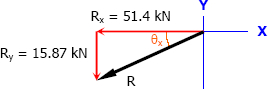 $R = \sqrt{{R_x}^2 + {R_y}^2}$
$R = \sqrt{51.40^2 + 15.87^2}$
$R = 53.79 \, \text{ lb}$
$\tan \theta_x = \dfrac{R_y}{R_x} = \dfrac{15.87}{51.40}$
$\theta_x = 17.16^\circ$
Thus, the net force on the ring is 53.79 lb downward to the left at θx = 17.16°.
012 Resultant of two velocity vectors
Problem 012
Find the resultant vector of vectors A and B shown in Fig. P-012.

Solution 012: Component Method
Click here to expand or collapse this section
$R_x = \Sigma F_x$
$R_x = 44 \cos 50^\circ - 17 \sin 70^\circ$
$R_x = 12.31 \, \text{ m/sec to the right}$
$R_y = \Sigma F_y$
$R_y = -44 \sin 50^\circ - 17 \cos 70^\circ$
$R_y = -27.89 \, \text{ m/sec}$
$R_y = 39.52 \, \text{ m/sec downward}$
$R = \sqrt{{R_x}^2 + {R_y}^2} = \sqrt{12.31^2 + 39.52^2}$
$R = 41.39 \, \text{ m/sec}$
$\tan \theta_x = \dfrac{R_y}{R_x} = \dfrac{39.52}{12.31}$
$\theta_x = 72.70^\circ$
The resultant vector R = 41.39 m/sec downward to the right at θx = 72.70°.
Another Solution: Vector Method
Click here to expand or collapse this section
${\bf A} = -17 \sin 70^\circ{\bf i} - 17 \cos 70^\circ{\bf j}$
${\bf A} = -15.97{\bf i} - 5.81{\bf j} \, \text{ m/sec}$
${\bf B} = 44 \cos 50^\circ{\bf i} - 44 \sin 50^\circ{\bf j}$
${\bf B} = 28.28{\bf i} - 33.70{\bf j} \, \text{ m/sec}$
${\bf R} = {\bf A} + {\bf B}$
${\bf R} = (-15.97 + 28.28){\bf i} + (-5.81 - 33.70){\bf j}$
${\bf R} = 12.31{\bf i} - 39.51{\bf j} \, \text{ m/sec}$
$R = \sqrt{{R_x}^2 + {R_y}^2} = \sqrt{12.31^2 + (-39.51)^2}$
$R = 41.39 \, \text{ m/sec}$ (okay!)
$\tan \theta_x = \dfrac{R_y}{R_x} = \dfrac{-39.52}{12.31}$
$\theta_x = -72.70^\circ$
$\theta_x = 72.70^\circ$ downward to the right (ok!)
Another Solution: Geometry Method
Click here to expand or collapse this section
 Cosine Law for the shaded triangle
$R^2 = 17^2 + 44^2 - 2(17)(44) \cos 70^\circ$
$R = 41.39 \, \text{ m/sec}$ (ok!)
By Sine Law
$\dfrac{R}{\sin 70^\circ} = \dfrac{17}{\sin \alpha}$
$\sin \alpha = \dfrac{17 \sin 70^\circ}{R} = \dfrac{17 \sin 70^\circ}{41.39}$
$\alpha = 22.70^\circ$
$\theta_x = 50 + \alpha = 50 + 22.70^\circ$
$\theta_x = 72.70^\circ$ (okay!)
013 Resultant of three forces with angles greater than 90 degree
Problem 013
Three vectors A, B, and C are shown in the figure below. Find one vector (magnitude and direction) that will have the same effect as the three vectors shown in Fig. P-013 below.

Solution 013
Click here to expand or collapse this section
$R_x = 100 \cos 37^\circ + 100 \cos 150^\circ + 80 \cos 233^\circ$
$R_x = -54.88 \, \text{ N}$
$R_x = 54.88 \, \text{ N to the left}$

$R_y = 100 \sin 37^\circ + 100 \sin 150^\circ + 80 \sin 233^\circ$
$R_y = 46.29 \, \text{ N}$
$R = \sqrt{{R_x}^2 + {R_y}^2}$
$R = \sqrt{54.88^2 + 46.29^2}$
$R = 71.79 \, \text{ N}$
 $\tan \theta_x = \dfrac{R_y}{R_x}$
$\tan \theta_x = \dfrac{46.29}{54.88}$
$\theta_x = 40.15^\circ$
$\theta = 180^\circ - \theta_x = 180^\circ - 40.15^\circ$
$\theta = 139.85^\circ$
$R = 71.79 \, \text{ N at } \, 139.85^\circ$ answer
014 Solving for force with given resultant
Problem 014
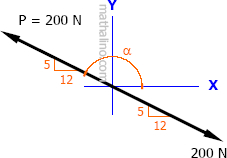
 From Fig. P-014, P is directed at an angle α from x-axis and the 200 N force is acting at a slope of 5 vertical to 12 horizontal.
- Find P and α if the resultant is 500 N to the right along the x-axis.
- Find P and α if the resultant is 500 N upward to the right with a slope of 3 horizontal to 4 vertical.
- Find P and α if the resultant is zero.
Solution 014
Click here to expand or collapse this section
Part a: The resultant is 500N to the right along the x-axis
By Cosine law of the shaded triangle
$P^2 = 200^2 + 500^2 - 2(200)(500) \cos \theta$
$P^2 = 200^2 + 500^2 - 2(200)(500)(\frac{12}{13})$
$P = 324.63 \, \text{ N}$ answer

By Sine law
$\dfrac{P}{\sin \theta} = \dfrac{200}{\sin \alpha}$
$\sin \alpha = \dfrac{200 \sin \theta}{P} = \dfrac{200 (\frac{5}{13})}{324.63}$
$\alpha = 13.71^\circ$ answer
Part b: The resultant is 500 N upward to the right with a slope of 3 horizontal to 4 vertical

$R_x = 500(\frac{3}{5}) = 300 \, \text{ N}$
$R_y = 500(\frac{4}{5}) = 400 \, \text{ N}$
$R_x = P \cos \alpha + 200(\frac{12}{13})$
$300 = P \cos \alpha + 184.61$
$P \cos \alpha = 115.39$
$P = \dfrac{115.39}{\cos \alpha}$
$R_y = P \sin \alpha - 200(\frac{5}{13})$
$400 = P \sin \alpha - 76.92$
$P \sin \alpha = 476.92$
$\left( \dfrac{115.39}{\cos \alpha} \right)\sin \alpha = 476.92$
$115.38 \tan \alpha = 476.92$
$\tan \alpha = 4.1335$
$\alpha = 76.4^\circ$ answer
$P = \dfrac{115.39}{\cos 76.4^\circ}$
$P = 490.68 \, \text{ N}$ answer
 Part c: The resultant is zero
The resultant is zero if P and the 200 N force are equal in magnitude, oppositely directed, and collinear.
$\alpha = 180^\circ - \arctan \frac{5}{12}$
$\alpha = 157.38^\circ$
Thus, P = 200 N at α = 157.38° answer
015 Solving for a force and its angle and angle of two forces with given resultant
Problem 015
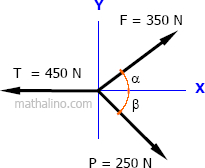
Forces F, P, and T are concurrent and acting in the direction as shown in Fig. P-015.

- Find the value of F and α if T = 450 N, P = 250 N, β = 30°, and the resultant is 300 N acting up along the y-axis.
- Find the value of F and α if T = 450 N, P = 250 N, β = 30° and the resultant is zero.
- Find the value of α and β if T = 450 N, P = 250 N, F = 350 N, and the resultant is zero.
Solution 015
Click here to expand or collapse this section
Part a: Unknown force and direction with non-zero resultant
$R_x = 0$ and $R_y = 300 \, \text{ N}$
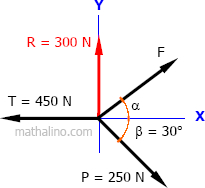 $R_x = \Sigma F_x$
$0 = F \cos \alpha + 250 \cos 30^\circ - 450$
$F \cos \alpha = 233.49$
$F = \dfrac{233.49}{\cos \alpha}$
$R_y = \Sigma F_y$
$300 = F \sin \alpha - 250 \sin 30^\circ$
$F \sin \alpha = 425$
$\left( \dfrac{233.49}{\cos \alpha} \right) \sin \alpha = 425$
$\tan \alpha = 1.8202$
$\alpha = 61.22^\circ$ answer
$F = \dfrac{233.49}{\cos 61.22^\circ}$
$F = 484.92 \, \text{ N}$ answer
Part b: Unknown force and direction with zero resultant
$R_x = 0$ and $R_y = 0$
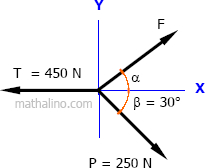 $R_x = \Sigma F_x$
$0 = F \cos \alpha + 250 \cos 30^\circ - 450$
$F \cos \alpha = 233.49$
$F = \dfrac{233.49}{\cos \alpha}$
$R_y = \Sigma F_y$
$0 = F \sin \alpha - 250 \sin 30^\circ$
$F \sin \alpha = 125$
$\left( \dfrac{233.49}{\cos \alpha} \right)\sin \alpha = 125$
$\tan \alpha = 0.5354$
$\alpha = 28.16^\circ$ answer
$F = \dfrac{233.49}{\cos 28.16^\circ}$
$F = 264.85 \, \text{ N}$ answer
Part c: Unknown direction of two forces with zero resultant
$R_x = 0$ and $R_y = 0$
 $R_y = \Sigma F_y$
$0 = 350 \sin \alpha - 250 \sin \beta$
$7 \sin \alpha - 5 \sin \alpha = 0$
$7 \sin \alpha = 5 \sin \beta$
$49 \sin^2 \alpha = 25 \sin^2 \beta$ → Equation (1)
$R_x = \Sigma F_x$
$0 = 350 \cos \alpha + 250 \cos \beta - 450$
$7 \cos \alpha + 5 \cos \beta - 9 = 0$
$7 \cos \alpha = 9 - 5 \cos \alpha$
$49 \cos^2 \alpha = (9 - 5 \cos \alpha)^2$
$49 \cos^2 \alpha = 81 - 90 \cos \beta + 25 \cos^2 \beta$ → Equation (2)
Equation (1) + Equation (2)
$49 \sin^2 \alpha + 49 \cos^2 \alpha = 25 \sin^2 \beta + (81 - 90 \cos \beta + 25 \cos^2 \beta)$
$49(\sin^2 \alpha + \cos^2 \alpha) = 25(\sin^2 \beta + \cos^2 \beta) + 81 - 90 \cos \beta$
$49(1) = 25(1) + 81 - 90 \cos \beta$
$90 \cos \beta = 25 + 81 - 49$
$\cos \beta = \frac{57}{90}$
$\beta = 50.70^\circ$ answer
From Equation (1)
$49 \sin^2 \alpha = 25 \sin^2 50.70^\circ$
$7 \sin \alpha = 5 \sin 50.70^\circ$
$\sin \alpha = \frac{5}{7} \sin 50.70^\circ$
$\alpha = 33.56^\circ$ answer
Another Solution for Part c
Click here to expand or collapse this section
By Cosine Law
$250^2 = 350^2 + 450^2 - 2(350)(450)\cos \alpha$
$\cos \alpha = \dfrac{350^2 + 450^2 - 250^2}{2(350)(450)}$
$\alpha = 33.557^\circ$ answer

$350^2 = 250^2 + 450^2 - 2(250)(450)\cos \beta$
$\cos \beta = \dfrac{250^2 + 450^2 - 350^2}{2(250)(450)}$
$\beta = 50.704^\circ$ answer