Superimposed or Built-up Beams
If a beam is composed of two or more thin layers placed on each other without any attachment, the separate layers would slide past each other and the total strength of the beam would be the sum of the strengths of the various layers. The strength of this beam is lesser than a solid beam having the same cross-sectional area.

Neglecting friction between any two adjacent layers, the following relationships may be used:
$I = I_1 + I_2 + I_3$
Curvature, M / EI = constant
Solution to Problem 559 | Built-up Beams
Problem 559
A beam is composed of 6 planks, each 100 mm wide and 20 mm thick, piled loosely on each other to an overall dimension of 100 mm wide by 120 mm high. (a) Compare the strength of such a beam with that of a solid beam of equal overall dimensions. (b) What would be the ratio if the built-up beam consisted of a 12 planks each 100 mm wide by 10 mm thick?
Solution 559
Click here to expand or collapse this section
Part (a)
 $I_1 = \dfrac{100(20^3)}{12}$
$I_1 = \frac{200\,000}{3} \, \text{mm}^4$
For the whole beam
$I = 6I_1 = 6(200\,000/3)$
$I = 400\,000 \, \text{mm}^4$
$\dfrac{M}{EI} = \dfrac{M_1}{E_1 I_1}$ where E1 = E
$\dfrac{M}{E(400\,000)} = \dfrac{M_1}{E(\frac{200\,000}{3})}$
$\dfrac{M_1}{M} = \dfrac{1}{6}$ answer
Part (b)
$I_1 = \dfrac{100(10^3)}{12}$
$I_1 = \frac{25\,000}{3} \, \text{mm}^4$
For the whole beam
$I = 12I_1 = 12(25\,000/3)$
$I = 100\,000 \, \text{mm}^4$
$\dfrac{M}{EI} = \dfrac{M_1}{E_1 I_1}$ where E1 = E
$\dfrac{M}{E(100\,000)} = \dfrac{M_1}{E(\frac{200\,000}{3})}$
$\dfrac{M_1}{M} = \dfrac{1}{12}$ ) answer
Solution to Problem 560 | Built-up Beams
Problem 560
The wide-flange beam shown in Fig. P-560 is strengthened by bolting two cover plates 160 mm by 20 mm to the top and bottom flanges. If the maximum flexure stress is 140 MPa, compute the total force (a) in each cover plate and (b) in each flange. Neglect the weakening effect of the bolt holes.

Solution 560
Click here to expand or collapse this section
$\dfrac{f_c}{190} = \dfrac{140}{200}; \,\, f_c = 133 \, \text{MPa}$
$\dfrac{f_f}{170} = \dfrac{140}{200}; \,\, f_f = 119 \, \text{MPa}$

(a) Force in each cover plate
$F_c = f_c A_c = 133(160 \times 20)$
$F_c = 425\,600 \, \text{N}$
$F_c = 425.6 \, \text{kN}$ answer
(b) Force in each flange
$F_f = f_f A_f = 119(160 \times 20)$
$F_f = 380\,800 \, \text{N}$
$F_f = 380.8 \, \text{kN}$ answer
Solution to Problem 561 | Built-up Beams
Problem 561
A T section has the dimensions given in Fig. P-561. Show that the neutral axis is 3 inches below the top and that INA = 166.7 in4. If the tensile stress at the bottom of the flange is 1000 psi, calculate (a) the total tensile force in the flange and (b) the total compressive force in the cross section. Also compute (c) the moment of the compressive force about the NA, and (d) the moment of the total tensile force about the NA. (e) How does the sum of (c) and (d) compare with the total applied bending moment as computed from the flexure formula?

Solution 561
Click here to expand or collapse this section
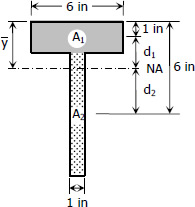 $A_1 = 6(2) = 12 \, \text{in}^2$
$A_2 = 1(8) = 8 \, \text{in}^2$
$A = A_1 + A_2 = 20 \, \text{in}^2$
$A \bar{y} = A_1 y_1 + A_2 y_2$
$20 \bar{y} = 12(1) + 8(6)$
$\bar{y} = 3 \, \text{m}$
$d_1 = y - 1 = 2 \, \text{in}$
$d_2 = 6 - y = 3 \, \text{in}$
$I_{NA} = (I_1 + A_1 {d_1}^2) + (I_2 + A_2 {d_2}^2)$
$I_{NA} = \left[ \dfrac{6(2^3)}{12} + 12(2^2) \right] + \left[ \dfrac{1(8^3)}{12} + 8(3^2) \right]$
$I_{NA} = 166.667 \, \text{in}^4$
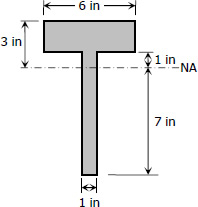 $f_b = \dfrac{My}{I}$
At the bottom of the flange (in tension)
$100 = \dfrac{M(1)}{166.667}$
$M = 166\,667 \, \text{lb}\cdot\text{in}$
At the top of the flange (in tension)
$f_{bt} = \dfrac{166\,667(3)}{166.667}$
$f_{bt} = 3000 \, \text{psi}$
At the bottom of the section (in compression)
$f_{bc} = \dfrac{166\,667(7)}{166.667}$
$f_{bc} = 7000 \, \text{psi}$
(a) Total tensile force in the flange:
$F = f_{flange} A_1$
$f_{flange} = \dfrac{f_{bottom\,\,of\,\,flange} + f_{top\,\,of\,\,flange}}{2}$
$f_{flange} = \dfrac{1000 + 3000}{2}$
$f_{flange} = 2000 \, \text{psi}$
$F = 2000(12) = 24\,000 \, \text{lb}$
$F = 24 \, \text{kips} \,\, $ answer
(b) Total compressive force (force below NA)
$F = f_{below\,\,NA} A_{below\,\,NA}$
$f_{below\,\,NA} = \dfrac{f_{at\,\,NA} + f_{bottom\,\,of\,\,section}}{2}$
$f_{below\,\,NA} = \dfrac{0 + 7000}{2}$
$f_{below\,\,NA} = 3500 \, \text{psi}$
$A_{below\,\,NA} = 7(1) = 7 \, \text{in}^2$
$F = 3500(7) = 24\,500 \, \text{lb}$
$F = 24.5 \, \text{ kips}$ answer
(c) Moment of the total compressive force about NA

$M_c = F_c \,d_c = 24.5(14/3)$
$M_c = 114.3 \, \text{kip}\cdot\text{in}$
(d) Moment of the total tensile force
F1 = tension force in the web
$F_1 = f_{web\,\,above\,\,NA} A_{web\,\,above\,\,NA}$
$f_{web\,\,above\,\,NA} = \dfrac{f_{at\,\,NA} + f_{at\,\,bottom\,\,of\,\,flange}}{2}$
$f_{web\,\,above\,\,NA} = \dfrac{0 + 100}{2} = 50 \, \text{psi}$
$A_{web\,\,above\,\,NA} = 1(1) = 1 \, \text{in}^2$
$F_1 = 50(1) = 50 \, \text{lb}$
$F_1 = 0.05 \, \text{kip}$
$d_1 = \frac{2}{3}(1) = \frac{2}{3} \, \text{in}$
Fflange = F in part (a)
Fflange = 24 kips
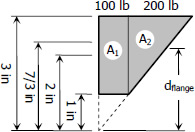 $A_1 = 2(100) = 200 \, \text{lb}$
$A_2 = \frac{1}{2}(200)(2) = 200 \, \text{lb}$
$A = A_1 + A_2 = 400 \, \text{lb}$
$A \, d_{flange} = A_1(2) + A_2(7/3)$
$400d_{flange} = 200(2) + 200(7/3)$
$d_{flange} = \frac{13}{6} \, \text{in}$
$M_t = F_{flange}\,d_{flange} + F_1 \, d_1$
$M_t = 24(\frac{13}{6}) + 0.05(\frac{2}{3})$
$M_t = 52.03 \, \text{ kip}\cdot\text{in}$ answer
Solution to Problem 562 | Unsymmetrical Beams
Problem 562
In any beam section having a maximum stress fb, show that the force on any partial area A' in Fig. P-562 is given by F = (fb/c)A'(barred y') , where (barred y') is the centroidal coordinate of A'. Also show that the moment of this force about the NA is M' = fb I'/c, where I' is the moment of inertia of the shaded area about the NA.

Solution 562
Click here to expand or collapse this section
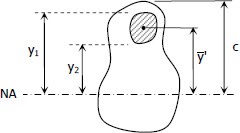 fb = stress at c
Let
f1 = stress at y1
f2 = stress at y2
$f_b = \dfrac{Mc}{I}$
$M = \dfrac{f_b \, I}{c}$
At y1:
$f_1 = \dfrac{My_1}{I} = \dfrac{\dfrac{f_b \, I}{c}y_1}{I}$
$f_1 = \dfrac{f_b \, y_1}{c}$
At y2:
$f_2 = \dfrac{My_2}{I} = \dfrac{\dfrac{f_b \, I}{c}y_2}{I}$
$f_2 = \dfrac{f_b \, y_2}{c}$
At (barred y'):
$f\,' = \dfrac{f_1 + f_2}{2} = \dfrac{\dfrac{f_b \, y_1}{c} + \dfrac{f_b \, y_2}{c}}{2}$
$f\,' = \dfrac{f_b}{c} \left( \dfrac{y_1 + y_2}{2} \right)$
$f\,' = \dfrac{f_b}{c}\,\bar{y}\,'$
$F = f\,' \, A' = \dfrac{f_b}{c}\,\bar{y}\,' \, A'$
$F = (f_b \, / \, c) \, A' \, \bar{y}\,'$ (okay!)
$M = F \bar{y}\,'$
$M = [ \, (f_b \, / \, c) \, A' \, \bar{y}\,' \, ] \, \bar{y}\,'$
$M = (f_b \, / \, c) \, A' \, \bar{y}\,'^2$
but $\,\, A' \, \bar{y}\,'^2 = I'$
thus,
$M = ( \, f_b \, / \, c \, ) \, I'$
$M = f_b \, I' \, / \, c$ (okay!)
Solution to Problem 563 | Unsymmetrical Beams
Problem 563
A box beam is made from 2-in. by 6-in. pieces screwed together as shown in Fig. P-563. If the maximum flexure stress is 1200 psi, compute the force acting on the shaded portion and the moment of this force about the NA. Hint: Use the results of Prob. 562.

Solution 563
Click here to expand or collapse this section
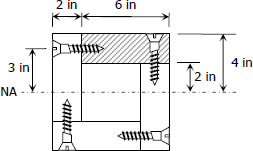 Force F acting on the shaded region
$F = ( \, f_b \, / \, c \, ) \, A' \, \bar{y} \, '$
$f_b = 1200 \, \text{ psi}$
$c = 4 \, \text{ in.}$
$A' = 6(2) = 12 \, \text{ in.}^2$
$\bar{y} \, ' = 3 \, \text{ in.}$
Thus,
$F = (1200/4)(12)(3)$
$F = 10 800 \, \text{lb}$
$F = 10.8 \, \text{kips}$ answer
Moment of F about the neutral axis
$M = f_b \, I' \, / \, c$
$I' = I + Ad^2$
$I' = \dfrac{6(2^3)}{12} + (6 \times 2)(3^2)$
$I' = 112 \, \text{in}^4$
Thus,
$M = 1200(112)/4$
$M = 33\,600 \, \text{lb}\cdot\text{in}$
$M = 2800 \, \text{lb}\cdot\text{ft}$ answer
Solution to Problem 564 | Unsymmetrical Beams
Problem 564
Repeat Prob. 563 using 2-in. by 10-in. pieces.
Solution 564
Click here to expand or collapse this section
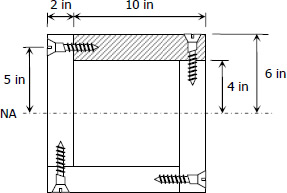 Force acting on the shaded region
$F = ( \, f_b \, / \, c \, ) \, A' \, y'$
$f_b = 1200 \, \text{ psi}$
$c = 6 \, \text{ in.}$
$A' = 10(2) = 20 \, \text{ in.}^2$
$y' = 5 \, \text{ in.}$
Thus,
$F = (1200/5)(20)(5)$
$F = 24\,000 lb$
$F = 24 \, \text{kips}$ answer
Moment of force F about NA
$M = f_b \, I' \, / \, c$
$I' = I + Ad^2$
$I' = \dfrac{10(2^3)}{12} + (10 \times 2)(5^2)$
$I' = 506.67 \, \text{in}^4$
Thus,
$M = 1200(506.67)/6$
$M = 101\,333.33 \, \text{lb}\cdot\text{in}$
$M = 8\,444.44 \, \text{lb}\cdot\text{ft}$