The Regular Polygon
Rhombus is a quadrilateral with all sides equal (equilateral). Rectangle is a quadrilateral with all included angles are equal (equiangular). Square is both equilateral and equiangular, thus square is a regular polygon. Regular polygons are polygons with all sides equal and all included angles equal. Meaning, regular polygons are both equilateral and equiangular.
Properties of regular polygons

- The center of the circumscribing circle, the center of inscribed circle, and the center of polygon itself are coincidence.
- All sides of regular polygon are equal in length; it is denoted by x in the figure.
- All included angles are equal; it is denoted by β.
- All external angles α, are equal.
- Central angles of each segment are equal; it is denoted by θ.
- The apothem is the radius of the inscribed circle, r.
- The number of sides is equal to the number of vertices, both are denoted by n.
- Diagonals that pass through the center has length equal to the diameter of the circumscribing circle.
- The triangular segment with area denoted as A1 is an isosceles triangle. The length of the two equal sides of this triangle is the radius of the circumscribing circle and the altitude of this triangle is the radius of the inscribed circle.
Formulas for a Regular Polygon
$A_1 = \frac{1}{2}R^2 \sin \theta$
$A = \dfrac{n}{2}xr$
$A = \dfrac{n}{2}R^2 \sin \theta$
$\alpha = \dfrac{360^\circ}{n}$
$\beta = 180^\circ \left( \dfrac{n - 2}{n} \right)$
Where
A1 = area of one segment
A = total area
x = length of side
r = radius of the inscribed circle (apothem)
R = radius of the circumscribing circle
n = number of sides
θ = central angle
α = exterior angle
β = interior angle
09 Dimensions of smaller equilateral triangle inside the circle
Problem
From the figure shown, ABC and DEF are equilateral triangles. Point E is the midpoint of AC and points D and F are on the circle circumscribing ABC. If AB is 12 cm, find DE.

Solution
Click here to expand or collapse this section
Let x = length of side DE
From right triangle CEB
$\sin 60^\circ = \dfrac{h}{12}$
$h = 12 \sin 60^\circ$
$h = 10.3923 \, \text{ cm}$
$\frac{1}{3}h = 3.4641 \, \text{ cm}$

Radius of the circle
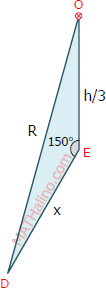 $R = OB = \frac{2}{3}h$
$R = 6.9282 \, \text{ cm}$
Cosine law for triangle DEO
$R^2 = x^2 + (\frac{1}{3}h)^2 - 2x(\frac{1}{3}h) \cos 150^\circ$
$6.9282^2 = x^2 + 3.4641^2 - 2x(3.4641)(-0.866)$
$48 = x^2 + 12 + 6x$
$x^2 + 6x - 36 = 0$
$x = 3.7082 \, \text{ and } \, -9.7082 \, \text{ (absurd)}$
$x = 3.7082 \, \text{ cm}$ answer
10 Area common to three squares inside the regular hexagon
Problem
Three squares are drawn so that each will contain a side of regular hexagon as shown in the given figure. If the hexagon has a perimeter of 60 in., compute the area of the region common to the three squares. The required area is the shaded region in the figure.

Solution
Click here to expand or collapse this section
 $P = nx$
$60 = 6x$
$x = 10 \, \text{ in.}$
$y = x \sin 60^\circ = 10 \sin 60^\circ$
$y = 5\sqrt{3} \, \text{ in.} = 8.6602 \, \text{ in.}$
$b = x - y = 10 - 8.6602$
$b = 1.3398 \, \text{ in.}$
From triangle ABC
$\tan 30^\circ = \dfrac{b}{a/2}$
 $a = \dfrac{2b}{\tan 30^\circ} = \dfrac{2(1.3398)}{\tan 30^\circ}$
$a = 4.6412 \, \text{ in.}$
$A = \frac{1}{2}a^2 \sin 60^\circ$
$A = \frac{1}{2}(4.6412^2) \sin 60^\circ$
$A = 9.327 \, \text{ in.}^2$ answer